A Kingdom for a Nail
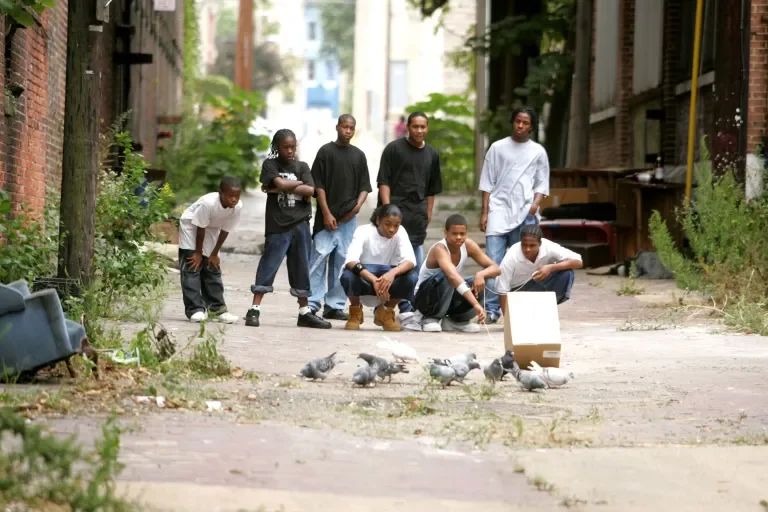
Picture it: United States of America, 2001. You are an old white man, a former Baltimore Sun reporter, and your writing partner, a former police officer and teacher, are in the HBO offices about to pitch a television series about the drug trade and broader sociopolitical and economic structure of Baltimore through the eyes of predominantly African American people, through all facets of the city, from the drug outfits themselves and the police officers to the dock workers and even the newspaper writers.
Now picture this in the United States of America, let’s say 2024. This picture is a little more cloudy. You are a Black woman, a Savannah State graduate, and you are pitching a show that follows a young Korean American girl adopted by Black parents, about to attend an HBCU in Georgia. You see it as an exploration of race and representation amongst cultures and peoples of mainly two varieties and from similar environments, and one trying to discover what that is for her, being from the outset since birth yet so close in step, at least that is what she believes.
Now that you have lived both lives, in your opinion, which one do you think receives love and critical acclaim from everyone, even a former president, and which series falters and garners backlash and hate for its tone-deaf story? Well, by now you should know it was “Southern Fried Rice,” and the Black woman that didn’t garner any applause in this story, and the white men received all of the love, greatly well deserved, I’ll add, and attention for their care and brilliance. The Wire and Southern Fried Rice are two shows wildly different in scope and detail, at least for the most part, and one show, The Wire, I have seen many times over, and the other, Southern Fried Rice, I have never seen and most likely will never watch, as this is my no-research playground. One I know is great and deserves all of the praise and then some, and the other, even cutting through the backlash, I understand is not the greatest show in the world. But besides these two points, the greater exploration is of time, place, circumstance, and honestly the idea of art and its holders in antiquity and beyond.
It’s best to start with David Simon and Ed Burns and the year 2001. The Wire, in and of itself, is an interesting show in its concept. A show depicting criminal activity against the police force of a city said to be interconnected with the political and economic structure surrounding the situations season to season is a show we see from time to time on various networks, but The Wire, in truth, has nothing in common with shows like Power, Snowfall, The Shield, or The Chi. The Wire is much more similar in concept and execution to an academic thesis given the breath of life as a show about crime in a major United States city. I could write my own thesis about it, but in brief, what sets The Wire apart is its sincerity and belief in what it depicts and its attempt to formulate and say something with each season focusing on a different and equally important facet within the city of Baltimore and all the players within it and how they function in the grander cycle of birth, death, obliteration, and revival, and the unrelenting subjugation of the invisible hand that guides and strangles all in its shadow: its system. There is very little grandeur or glory in action; the deaths in the show aren’t spectacles, they are quick and silent. The characters, from the lowest man on the corner to the highest man in office, are all bound and beholden to something. Every organization has a code and lives by it and breaks it, from the drug dealers to the media of the city, and each, as the world evolves, what once was held dear, what once was given respect, what meant so much to all those, enemy and friend alike, means nothing to a new generation, and the same will happen to them.
That is the beauty of The Wire, how genuine it is in approach and perspective, never showing one side as better or superior to another, everyone equal, all kowtowing towards the same Babel they build, conscious of it or not. I can go on and on, but the point is how do two white men do this exactly? Now let’s be fair. Of course this is possible and can happen, but you would not expect it, especially during 2001, but with hindsight, 2001 might have been the perfect time to make such a thing, where all the stars could align. David Simon was a reporter for The Baltimore Sun for twelve years and covered crime and the police department and wrote two crime books similar in concept, The Corner being the most notable, that was adapted into television. These same topics he lived and reported on are the same that he would go on to cover in The Wire. As a journalist, Simon cultivated a relationship with Ed Burns, who was a Baltimore city police officer for twenty years and was a public school teacher in Baltimore and helped Simon write The Corner. In the truest sense, it is writing what you know, one living the experience and the other writing about it. Burns and Simon would bring in other authors who had written similar crime stories such as Dennis Lehane, George Pelecanos, and Richard Price, who had written urban crime fiction similar to theirs. This was an occurrence for them, bringing in outside people with experience and knowledge on things that they wanted to speak to in the series. Such as Rafael Alvarez, who brought his knowledge of the Baltimore docks, and William F. Zorzi, who was a political journalist; each brought their experience and knowledge to each season. They didn’t want spectacle; they wanted a holistic crime novel mixed with an academic thesis brought to the screen that required and rewarded your time. This is aside from all the interviews conducted and the relationships built and used in the city of Baltimore itself to bring the series to life. They committed to the story, the world they wanted to shape and tell.
Ed Burns and David Simon wanted the truth and were fed the truth by passion and a desire to understand. It’s a story, a show that was hard to make, and even in its perfection they had to fight for every season, and the grander climate of the 2000s might have played a part in its creation. Them being white and having a relationship with HBO beforehand probably got them in the room, and their experience and love birthed the story it is today, but The Wire, with that same fervor and love and passion, could have been written by anyone. Black, white, Asian, Jewish, Native American, Polynesian, and we can keep going, because stories have no holders or owners they are not fettered in chains in the bottom of dungeons held by different ethnicities. They are welcome and beholden to all. What makes them good, what makes them bad, is their passion and truth, their honesty and love, their care and curiosity, their relentless nature and discipline; everything else is up to chance.
Now let’s talk about Southern Fried Rice. Admittedly, I don’t have nearly as much love and care for it as I do for The Wire, nor have I seen it, but I do care for the attempt as much as I care for The Wire. It was a series based on concept alone that birthed backlash. On the KeyTV network, created by Keke Palmer, the show itself was created by a Black woman named Nakia Stephens. It is a show that was created to show the experience of a Korean woman raised by Black parents attending an HBCU. You can see the understanding and purpose for creation: a young woman raised in an experience unlike her own ethnicity but who has a found home inside of it, now on her own to experience where her place is in a culture already abused and taken by so many outside of it and how she fits into a found family and culture rather than one born into, and if that culture itself has any place in her. An interesting story that cannot be denied and a story that deserves to be told, because it is one I find the arguments against childish, but I will discuss that soon. Nakia Stephens has written many things in the industry, from television series to films, some being Baby Blue, Tell Me, and Tre, to name a few. From the beginning of her career as a writer and in the industry, what she seems to champion the most is the ability to give marginalized voices space to tell their stories and any that they wish to tell. She created Damn Write Originals, a screenwriting label, for that very purpose, to support that vision and belief for herself and others. Telling these diverse stories and telling the ones she wishes to tell, she herself doesn’t tell people how to feel but hopes that they feel something strongly. That is something to speak to in the sense that when telling stories of your own or others, it is the place and purpose behind the words that make all the difference. It’s something unexplainable and imperceivable that you can’t speak to, but you feel it. From the best of things to the worst, the purpose can snatch you when it is real, when it is genuine. It is an innate feeling that we all have that seems to call back to something more wild, more feral in us, or better yet, primordial. It is the sunken affirmation that says, “I see you.”
Not seeing the show, I cannot speak to execution, but from what I have heard and understand, it was not the greatest series ever made from how it portrays the main character in question, Koko, and the other Black characters around her and her arc in the first season. In its imperfection, it is hard to say how much distaste is spoken in its name based on the actual product versus the concept itself. The problem with the situation is that you can’t tell a story about an Asian woman going to an HBCU. I have one hundred percent certainty that an Asian woman has attended an HBCU, that I am sure is a fact and a fact that needs no proof if you live in this world. And to this point, if an Asian woman had never attended an HBCU, it would not matter anyway; the story still deserves to be told. In that same instance, it can be told by a Black woman, same as a story about Black Baltimore drug dealers can be told by white men. The idea that stories have owners based on experience or ethnicity entirely takes the creativity, heart, and the enchanting nature out of storytelling. It’s confining every man and woman to not the country, the city, the town, but the street they grew up on, perpetually walking in their cul-de-sacs with a map that has but one road, all borders, no bridge, no room to breathe. A singular view, less than tunnel vision, smaller than the eye of a needle, filled with racehorses neutered and sheep full of wool.
If nothing is true of David Simon, Ed Burns, Nakia Stephens, and the many multitude of artists, writers, authors, musicians, and creators of all kinds, their singular uniting truth is that they all can tell any story they choose. Stories have no keepers, no holders, no owners, no flaming swords floating in front of their gardens. They are there for all of us, and they simply need taking. It’s the same idea of screenwriters having the same idea; it’s the same understanding that many different comedians can think of the same joke. They are not sectioned off by ethnicity or circumstance; they simply and unequivocally are.
One Battle After Another, a story focusing on race and specifically Black women, was met with a lot of discourse around the film and its themes, specifically on the character Perfida Beverly Hills. Perfida Beverly Hills, without a doubt, is the single most important character in the film, given she is the catalyst and, throughout most of the movie, the most powerful—not from strength or systemic effects, but through influence. She is constantly running, both literally and figuratively. From her citations in the movie, from the movement she is meant to carry on for generations before her, the weight of motherhood, and the purpose and estimation everyone places on her throughout the movie. Also hypersexual, and to a point that makes you take a step back, but it is often used in a way of manipulation, and that sexuality is also placed upon her through both protagonist Pat and Antagonist Lockjaw within the film. What makes her stand out as a great character is her selfishness, its effects on her and consequences it holds a generation after. In any story of any form it’s important to never judge that character as good or bad. With stories, and especially the good ones, the characters that are created and placed on screen have soul and affect, and an effect often much greater than we ever give them credit for.
When they are Black characters and written this way, and specifically Black women, Black people begin to judge and question. The protection is understood, given the representation of Black people and explicitly Black women throughout media, but protection cannot be called in the name of upholding some preserved form or ideal of what Black women can be and represent within film, because in my estimation that is much worse than any Perfida Beverly Hills. True equality, understanding, representation, and the true forms of all things is when we can be all things, because like most humans on this earth, we have been all things. If done well, it deserves all flowers, and poorly is when you sic the dogs. This is an issue in fiction and in life that needs better examination and thought, because one can protect Black women as beings while the form and output deserves questioning. This is all to say her realization in the story was written and directed by a white man, Paul Thomas Anderson. Yes, he is married to a Black woman and has mixed children, but he has not lived that experience, and proximity does not grant authenticity, and in that same aspect, it does not matter. Amistad, American Gangster, Ray, Lovecraft Country, and so many more were written by white people. This isn’t to say or give a pass that white writers and directors can tell Black stories, as the point is not biracial; the point is multicultural and inviting of all ethnicities and people of all ages. White and Black are merely examples, as a movie like Slumdog Millionaire can prove the same point.
When thinking of this question, Jackie Brown came to mind. A film based on a novel by a white man, Elmore Leonard, and written and directed by Quentin Tarantino. I imagine if you are reading this, I need not go into Tarantino’s extensive history over the use of the N-word in his films through his characters, some he has portrayed personally, I should add, and the many, many other problems with him as a person. Although in this instance, with Jackie Brown and the phenomenal individual that is Pam Grier herself, he shows such love and care to her and the character. The same can be said of many of his Black characters, such as Django, but Jackie Brown is the most interesting, I find, especially coming from someone such as himself. What I question and try to understand is the why? He, as a person, loves films and movies—that is understandable—and has shown respect and care to Black actors and them as characters, and I am sure he has seen many blaxploitation films given his age and profession, so it all, in a way, comes together. Unrelated, maybe related, he has mentioned growing up that his mother dated Black men, so there could also be something that can explain more, but that is following deeper into speculation and away from hypothesis. There may be an interview or answer out there of him personally giving his reasons as to why, but as has been said before and will be again, this is not the place for research. Tarantino giving such love and care is not nearly as documented as David Simon and Ed Burns, and not in the same proximity to the situation or people either, at least not as well documented. So it leaves me at a place that I fall to when it comes to the formerly spoken place of sunken affirmation. I don’t think anyone can truly explain why Tarantino or others would tell such a story, what would drives them to give up years of their life and to give birth to something that they have no visible relation to. Maybe he can, but in honesty, I doubt he truly could. Yes, he could give words and anecdotes and different cited sources and people, but those are just answers to asked questions, not truths acquired from one’s soul, and in the same silent understanding, they don’t need to be. Not for Tarantino and all his problems, and neither for Nakia Stephens, because what good, what purpose, what is the point in all of this if examination, if explanation, and if hearing must follow?
A Black man deserves the right to tell a story about a young Chinese woman growing up in the Ming dynasty. An Asian woman deserves the right to tell the story of mixed African and French children growing up in Canada. An Indian man can tell the story of a white woman living in the deep American South. And a Black woman can tell the story of a Korean girl going to an HBCU. The question is not who can tell a story, but if the story is told well. I understand the true problem is that white people are given a greater say and the ability to tell their stories and the stories of others. That was seen this year between Paul Thomas Anderson and Ryan Coogler. The willingness to give Paul Thomas Anderson all that he desires, knowing he is a filmmaker who never turns great profits, and Ryan Coogler battling for every cent, and even when the movie is a breakout hit and making all the money in the world, it is questioned even then for its profitability and left off best movie of the year lists and will likely not win many rewards through the season. That is the problem. That is our fight, and where the blood needs to be shed. Nakia Stephens and David Simon both have the right and should be given the support to tell all stories they want to tell of all cultures, but the hill to die on, the battle being waged, and one in which I pledge eternal service, is when we all can be given the ability to tell the stories we wish to tell. Not why is Nakia Stephens telling that story, but why can’t more Nakia Stephens tell the stories they choose.
As I wrote this, the thought of dogs seeped into my head, and particularly how they shake. Not to shake the water or snow, but they shake themselves periodically. I have no interest in looking up the reason on the internet, as I’d rather not spoil my thoughts with truth and scientific speculation, but the action seems primal. The function of yesteryear still rearing its facade over an animal bred and tamed to support man at every function, an animal crafted for purpose through the hands of counterfeit gods for various functions through society, given commands to follow without question. Still, they shake, a thing from a bygone era, its purpose of clearing rainwater from its coat and other things surely, but in a house, no water in sight, no snow, no outside force imposing itself onto the animal, it still shakes. Maybe it had its purpose long ago in the wild and the woods. Maybe the wolves shake knowingly and for a reason, but the more I think about it, a wolf so in tune with its nature, bred and evolved for its own pursuit and functions, still shakes, but I would have to guess it does so knowingly. Being from the wild and of it, and then again I am torn in a completely different area, for if the wolf is in the wild, chances slim it sees it as such. It sees its environment and life as its own society and sanctuary, tamed in its own way, but it lives how it lives. No houses, no commands to sit, stay, come, bad boy, or good boy. The wolf stays the wolf. Just a thought I wondered, but even now it refuses to leave me.