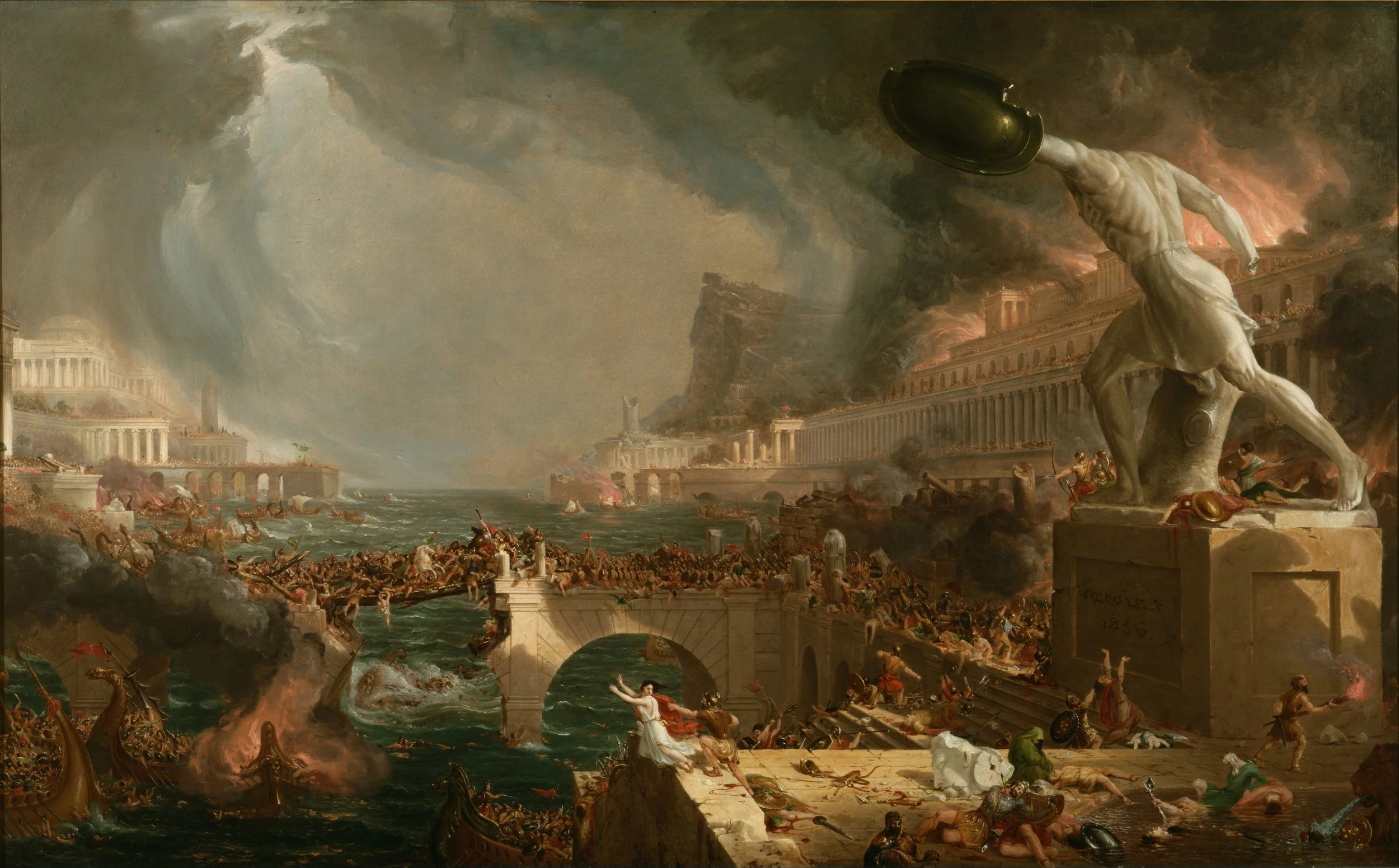
Thomas Cole, The Course of Empire, Destruction, 1836
You left me. You left me alone in that room with the Minotaur. We circled each other like two wolves, alpha and omega, fighting for dominance but, in truth, our survival. I take the first action, and I attack! With each slash, each step closer, I get further and further, closer to that evil, that hovering circle that will bask in its fiery glory above its head. An evil tone it hums as it teleports above it, telling each of us of a coming outcome. The more I advance, the more I push forward; it is there. It is finally there! So I do it. Right quarter-circle turn. Left quarter-circle turn. Circle again! A blow to the metal-bound beast as I am on top of its back. And then we’re here. We’re here again, this evil, evil place. That blazing square appears and asks for an audience, for a personal bashing to fulfill its sick, masochistic fantasy. I am doing it. I am doing it. As you taught me, not so much a press but a glide back and forth, left to right, with fury, with rage, with great vengeance. It will be mine. He will be mine! The Minotaur rears its head, dazes me, and throws me back toward the wall again. I am met with the same wall. The same beams. The same fiery structure as it begins its advance of our eternal dance.
A dance I did not ask for. A fight I did not want. A labyrinth I did not choose to be in. But I am here. Oh, how I am reminded that I am here. And alone this time for the first ever. Alone to face the fuming snorts of an anger-filled, mad beast. And much, much worse than that, as I drop to my knees, begging, pleading, crying, “Someone end this! Someone stop my torment!” No one responds. No one listens as I attack the ground, as the horned god subsides. Time stops, and I am frozen. I am still as his advance is frozen, and we are brought to the same place, forced to continue this humiliation, this trial of contempt. Oh God, how my hero has abandoned me. Even isolated, I cannot leave the solitude for what it might mean for myself and the one who put me here.
It was only days before, on July 19th, I had seen Bill & Ted’s Bogus Journey. A film about two best friends who are killed by future evil robot versions of themselves and must journey through Heaven and Hell to save the future. An idiotic movie, I thought. Creative, interesting, enjoyable, but idiotic. What stood out to me, what I did not know I would take away, what I was unsure would take me out of my labyrinth, were the words on their statue at the beginning: “Be excellent to each other.”
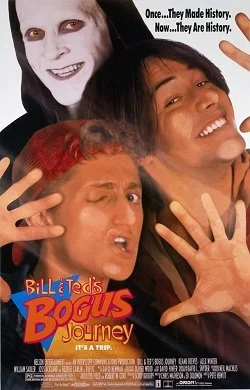
Bill and Ted’s Bogus Journey
It seems so small and so childish, an afterthought, after all. But as I rushed to that room the next day, only a day away from my predicament, it came to me. Or more so a revelation, as I began my trek, taking the path not of choice but because you had left me, forced me down this road as some sick pilgrimage. Bill and Ted, as idiotic as they may have been, how couldn’t you love them? How couldn’t you root for them? How couldn’t you respect their love for the music they played and the determination they shared? They may not have known, may not have seen, but what they did while they lived would carry itself to the utopia of the future. A future whose foundation is to “Be excellent to each other.” Where classrooms speak of the great works they did and the unity that was created amongst people to unite the world. Words and actions said and done in the past affect the future. There is no better swan song, is there? There is no better legacy.
That’s when it had hit me. That’s when it had revealed itself to me in that dungeon, inside my containment of infinite regress. That is why it mattered. That gave it its importance. I may not have fought someone from the future in my current day, but what I did on the desert adventure, what I decided to do against the Minotaur, would mean more than I ever thought.
The idea of being excellent to each other was not written on that day. It was birthed in that past through the decisions of two boys trying to be excellent to one another and everyone else every day. In the face of circumstances and villainy, they had no choice but to face it as it was pressed upon them, same as I. As deliberate as their actions were, they never knew how it would affect the future, how important those thoughtless, meaningful actions were. That is what it is, is it not? It is written where and when you are stamped with each step you take and have taken. No one asks of a man to throw your stone far, and that is what we will make of you. No, they ask of a man to carry your stone far, and how you walk is how much worth you have today. Man is studied like a performance perpetually acted. In the moments of solitude, in the moments of grandeur, man is only respected and given life in what he does. He is remembered fondly based on how he carried it, not what he carried it for. The weight is always unbearable, is it not? Then, my friend, you must carry your weight for those who come after. Be excellent to others today so that the world can be excellent to itself tomorrow.
As I learned this, as I thought these things, I simultaneously learned of the burning of Rome. You taught me that because you thought it was funny in a way. Nero, the emperor of Rome, burned the city, as the story goes. Its own emperor is said to have played the fiddle as he watched it blaze, for he was an artist and a fair emperor before he was the cruel, poor emperor we would come to know. But no fiddle was played because it did not exist. He did not burn the city. He was thirty miles away in Antium, and when he heard of its burning, he returned and let those who were affected into his home. Nero, I have learned the times, and people tell many truths, and many truths they have left out.
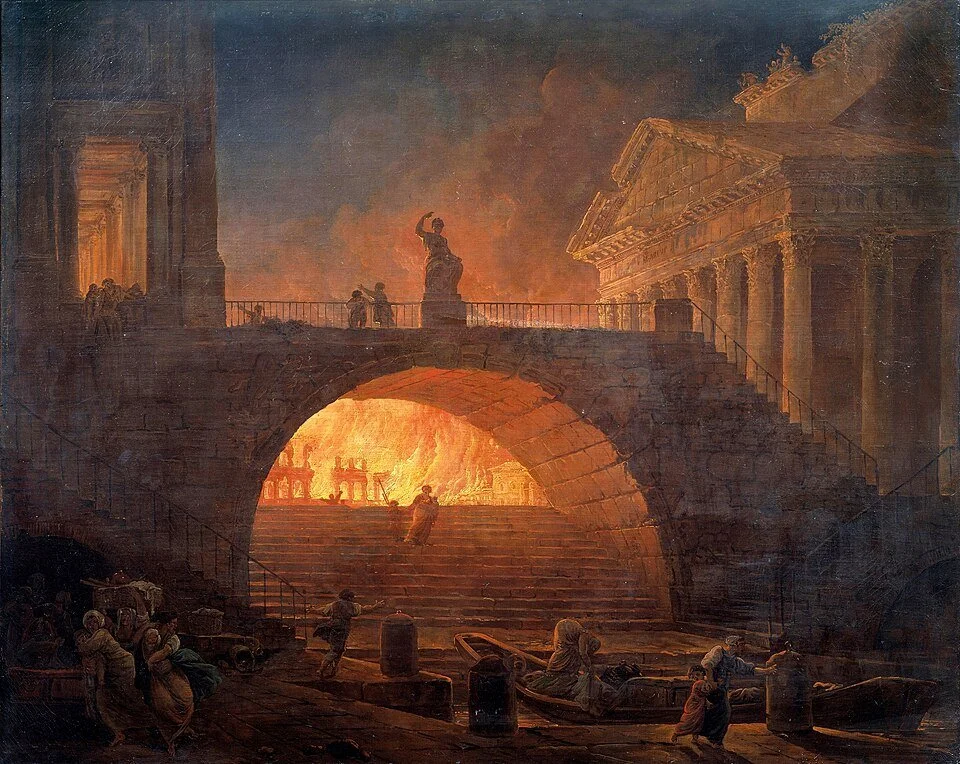
Fire in Rome by Hubert Robert (1785)
So, how does a man come to be known for such things? I was confused. Distinctly, I remember thinking about it during the various nights in the facility alone, doing various drills, bags, or running otherwise. Doing various things to make myself better. An artistry in its own right and requirement of myself, and through it an unseen gift to lead more resolutely. It wasn’t the night that made it memorable but the encounter that night.
“Why are you always here? Go home!” a friend had said to me as he was leaving with dinner in his hand.
My only response at the time: “Too much I gotta do to be home chilling. If I’m not working, what am I doing?”
Odd, because it never felt like work. I didn’t know how much it would mean to me or others, how formative it would be for another. It felt like something that I loved to do, wanted to do. It was a need, I suppose. A heuristic built long, long ago when I couldn’t keep up during our runs, when I worked out with you as you worked toward your goals. As you solved the puzzles as you glided your two fingers back and forth with perfection, I watched in awe as you did it without a thought. I couldn’t keep up then. After all, I got tired because I asked, “Why are we still here?” “How am I supposed to do that like you?” You didn’t say any words to me, didn’t acknowledge my question, but you just kept moving. At the time, it felt like an automaton, but in truth, as I put my headphones back in and my friend acknowledged me taking more steps, running through more bags, I wondered if he would understand as I did you. Or is this me talking now, giving intentionality to an action that I was taught to do? It was dogma, was it not? My reality was built long ago. A continuation from that pilgrimage in the desert that I came out of, that you left me to do, that I refused to dismiss for what it meant. A meaning that berates me now and may not have been there then because how was I supposed to know how important it was? The workout was the workout; it’s what I did after my desk work in the office. Was it ever more than that?
Nero, I now see why he is remembered for the fires, not for a false recognition, but because of how he carried it. After the burning is when the good emperor fell to his madness, torturing and murdering a people as a scapegoat to a false rumor he feared. He built his palace that was an expanse rivaled by the vastness of the sea in the heart of Rome. He killed more, taxed more, causing far more pain, to run from an idea that he was giving birth to. As good a man as he was early, he gave room for the pens decades after to speak, write over it all, exclaiming heinous depravity.
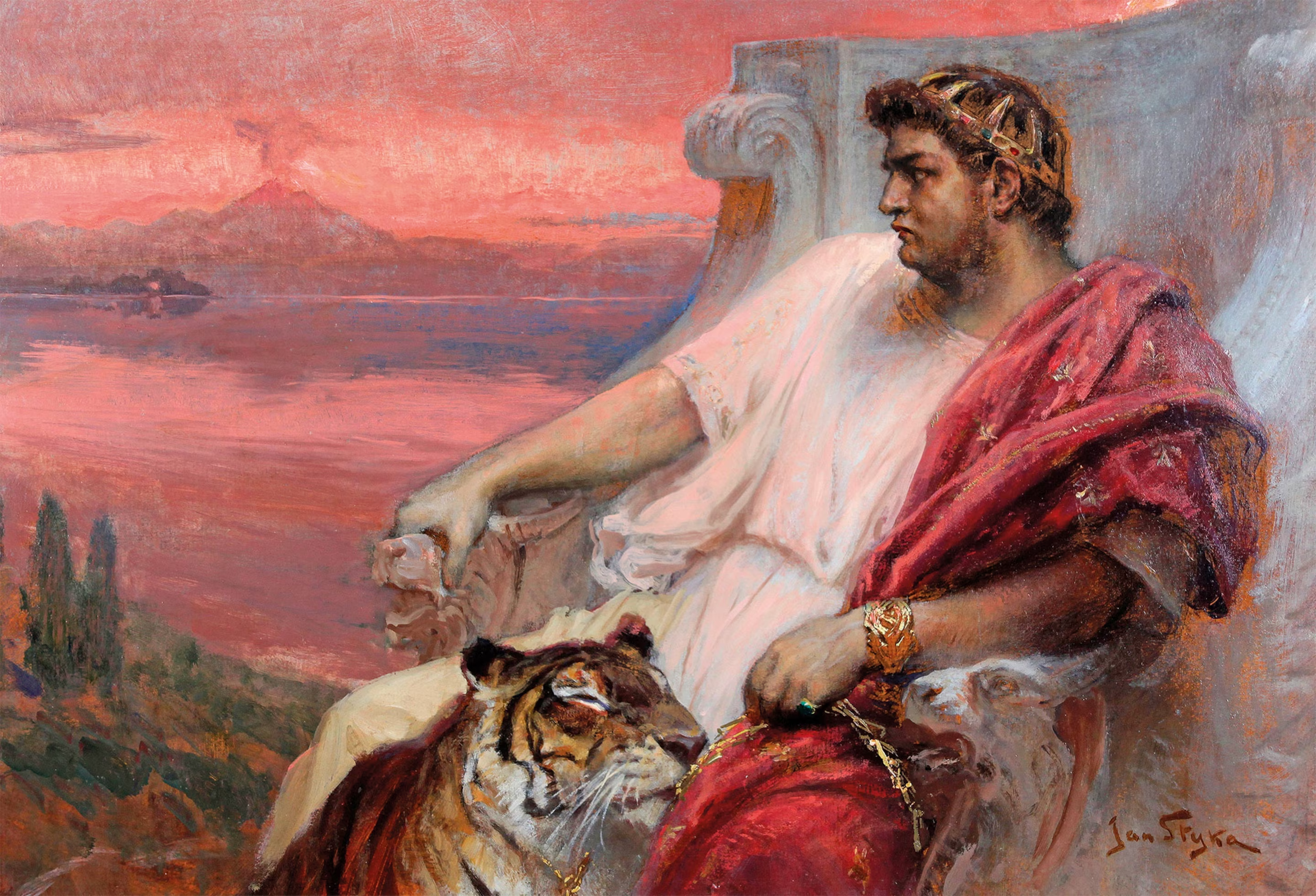
Nero at Baiae by Jan Styka 1900
Nero would eventually kill himself as he ran away with the help of a servant. His final words would be, “What an artist dies in me!” Who remembers these words? Who hears them and remembers Nero, the emperor of Rome? That Nero was loved by the common people for a long time and did good for every man? As Damocles’ sword swayed over his neck, he stood in the face of his demise resolute. It is not the man who tells people how he took his steps; it is only those who saw it and those who interpret, and some voices are much louder than the others, and in a future that gives them no benefit to tell all the truths, their vituperatio, bitter condemnations, were of greater importance. So it is written and told that the man was little more than a boy lost on the geographic step of time, begging, crying, and pleading for more.
I see little similarity in Nero and in myself, but what I do see is ourselves, the only thing that makes us whole. As time had made us foes, this examination has made us brothers. He carried how he saw others before him carry. The more I see my brother, the more I realize how different, how intricate he was. His love of artists and the common people, He made it easier for people to earn a living, gave slaves a higher standing in society, and ended a war. But the rich saw it as mockery of the title and, even more so, those actions didn’t line their pockets.
He is memorable for a story that had not happened but cannot explain better the man he was because that is how he chose to carry it, because others had not taught and he had not seen, and though in the beginning he chose better, he would himself throw it all away. For that weight, that boulder through time that we carry, we often exclaim that we do it of our own volition, our own will. For I carry my burdens because I have formed them, because I will surmount them! No, what my brother Nero and I have in common, that my brothers Bill and Ted and I are missing in our compatibility, is that we understand we carry something forward past ourselves. We are more than the choices we make, as legacy is more than the ideas and actions one does. It is built upon an expulsion of what heritage, of providence, we have come to know, to see, learn, and hold. It is our past, the thing that makes up the self.
The unbreakable bond my brother Nero and I share is that our kismet is one of choosing, that we expel it into the future by how we have walked and seen others walk before. We simply came to different conclusions, is all. No one may remember his final cries of what an artist he was, but they do remember the burning of Rome during his reign as he played the fiddle. They have no memory of the good that he did for his people as his political enemies shunned and surrounded him for it. But they remembered the story, the tale of the brutal murder of his pregnant wife that may not even be true. But like him and his fiddle, a story false in creation, but all the same deserving and all the same purpose as the statue of Bill and Ted, a story told in the future to give examples of men to be and not to be who took steps they thought were right but uncertain of what the plaque on their statue would say.
“Aye! Aye! Look at this, look at this!” a friend shouted to me on the phone from the same office I used to work in. Doing the same work now that I used to do. The work that brought kids that looked like me from a community into ours, showing them all what they can do, what they will do. A desk where I had written and planned many events to discuss the events of the world, same as I do now, same as I did back then, but so that all people of our campus could discuss and grow from such a thing. Although it feels like the black mass circles as the brimstone falls from fiery skies that sing finality, that dance to the rhythm of forsaken torment, you can walk. Take another step as I am, as you can do. As the rest of us choose to do.
That is what that desk meant to me. It was happenstance that I had even found it. I ran into the man who worked above it himself, asking if I was looking for something to do, if I could help out. He thought I would be a good fit from what he had heard of me. I thought of many excuses. More writing, more bag drills, more and more of what the other options held for me.
Then I thought of you. I thought of the help you provided to your own world, how it made you smile, how you gave back to people who thought they couldn’t be something, and you showed them they could grasp the world. All they need do is reach out their hand. I shook my head yes and told him I would be there.
It led to a previous conversation my friend and I had in an elevator, him asking where I was going, and I said, “To work.” He asked, “How much do you get?” I said, “Nothing. It ain’t always about that.” We said our brief goodbyes, and I left the elevator to work. I only thought about it as we laughed and talked hundreds of miles away, but one desk, one conversation made us centimeters apart.
In the wake of the death of Lindsey Graham, I see fully what it means to carry it one way versus another. How he carried it to stay in office, no matter the cost. To support men who think very little of most groups except the ones they reside in. To support many aims and movements that lead to no good places, he was a man of many follies. His peers on The Hill remember him fondly, remember how much they enjoyed and laughed with him. They speak highly of him when he had done so little for the people that actually needed him. They chuckle and reminisce, gourmandize on their thoughts and words, as towns and people are left with far, far less stomach and back, sharing memories as they embrace dry mouths struggling to speak, raised arms asking for just a sparing, if nothing else. I may be too harsh, as men are not singular and can wear many faces.

U.S. Sen. Lindsey Graham, Republican of South Carolina, appears at a press conference on April 27, 2026, in Washington, DC. Heather Diehl
Lindsey Graham himself, as Martin Luther King III walked into his office with a plan, with great work, Graham commended him on it and told him to keep working toward it, to keep going, and that it was great, it was beautiful, it was something he could not support, but that it was amazing, truly, but he could not support.
This is where I see ourselves now in each other, a crossroads with no signpost, as it is your decision what to call such destinations. For who he was as a politician, the man that he desired to be, did not allow him to support that good deed, but it made him support others. And in that, I see this carrying of the boulder, this legacy, to be a farce because what is the point? He will become another politician, another man down the road, and like all politicians, all men, you are forgotten, not even a breeze in the wind, a speck of sand on the eternal shore. However, it means so much to us because it does have an effect. As we throw our boulder, as we become little more than lent, making an odyssey across the floor, how one is remembered affects all of those who came into contact with you. It is the finishing note in a life lived and the result of whether it was lived well. Not from achievement or grandeur, but the small crossings from one friend to another, that the pay is the afterthought. That home can wait; there is more to be done. I just wonder what others would say about Graham if people allowed them to exclaim as loudly.
My back against the wall, I dash into the entity again. Dodge, slash! Jump, attack! Roll, stab! A sequence of beauty, choreographed demonstration, and we are brought to the same destination. As the Minotaur sways back and forth, I see the malevolent circle appear. I see you there, I yell. I see the enemy of my enemy, and I force you to become my friend. I mount the lumbering beast. Quarter-circle turn right! Quarter-circle turn left! Circle again and square and circle and triangle and then the square shows itself! Not a press but the glide that you taught me! I glide and glide, mistake with a press and then glide more. Silence fills me first as I see something different, and then I did it! Sweat dripping from brow and hand alike, I rush back. I run to the lever and pull it with the little might I have left and impale the beast, the Minotaur, against the door as it raves and wails, screams its dying breath. I rush into the next room and tell you, “Look! Look at what I have done! Look at what I did!” It was your plan, after all. If you can’t do it yourself, then you simply can’t do it. But now I can. Now I could. That was my heritage, how I carried my boulder, how I would throw it into the future for others to see. My victory, the slaying of the Minotaur. I had won this day.
As I passed the door with a revelation only my future self would understand now, the importance of the small moments, of the little things that made my walk important, I saw it hang. I saw it lifeless there, pinned against the behemoth door. I thought about the many who had come before my own journey, before my own battle. All those who had fought him and lost and given up, how many wills he had broken and claimed. Now he was there against the door, a memory of my achievement, the building block of being excellent to others, a reaction that I decided to win.
But his skin would peel, muscles would fall away, and a skeleton would be left for others who would pass that same door without the challenge. They would see that same bolt through his chest, holding little more than an intricate design of a cage where a heart used to be. As they passed, I wondered what they would think. Would they see the quarter-circle turns and the dashes and the attacks? The tears, the sweat, the blood, the summation of surmounting that let them walk free? Would it be an afterthought as they walked past onto the next cleared room, enjoying the view, taking in the scenery? Would the swinging corpse hold importance?
It may be more likely they would never even notice, not care at all to look up, moving forward and walking without a thought in the world. After so much triumph, I thought about these things for a great bit of time afterward. It bothered me that I cared because why should I? Selfishness, maybe, or was it something else? Still, deep down inside me, small and nothing more than a squeak, I am positive I still wonder what they all think. I still ask: do they see how it was open, all that was left? I ask and ask, and I wonder, but maybe it is a waste because they are walking through that same door after all. So who really cares?