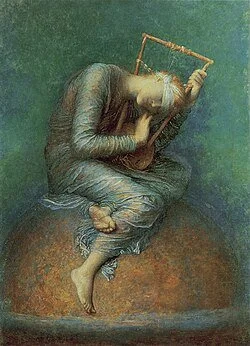
George Frederic Watts, "Hope" (1886)
“What else was he supposed to do?” I remember that question I asked you that same July 12th, years and years ago, as we finished watching Boyz n the Hood. Doughboy, losing a brother and a mother all in one night, wakes up for a morning he can’t recall seeing in recent memory. A morning that speaks to him all the same as his nights do, of drinking, selling, and, this time, no killing. The only difference is presented to him from a black screen, a peek behind the veil. It tells him of a “violent world,” a world of foreign lands, desolate, destroyed, and demolished, found in cycles of violence, recurring scenes and pictures that haunt them. As the world reveals itself to Doughboy for the first time, he wonders whether they don’t know, don’t show, or don’t care about what’s going on in the hood. This is the moment. This is the change. This is the lifting of him from the continued repetition, his continued cycle of drinking, selling, and maybe killing. This realization allows him to break free. But it doesn’t. All it does is give him clarity. It gives him the understanding that as this cycle continues to turn, he has found himself toward the end of the forever-spinning wheel. Having killed a brother, a son, a father, he knows it is only a matter of time before they come for him, and that is simply how it is.
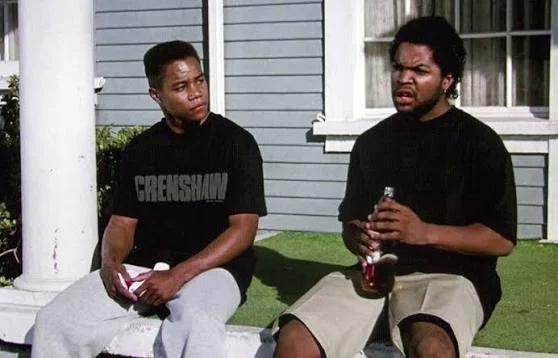
Final scene of Boyz in the Hood
“Simply how it is,” sister, is a frightening phrase. “Simply how it is” seems like bowing toward the cycle that abuses you. A letting go of autonomy. Although “simply how it is” is something I’ve grown to see clearly, as all humans are rational and completely irrational beings. As he has found himself within a cycle many have been in before him, and many will continue to find themselves in after him, he never really had a choice, did he, sister? It was a need, a necessity, one described in the simplest, easiest phrase: survival. To live in a violent world, in a world that offers you little solace, a world that treats you as a second-tier son, a world that takes any advantage you have away, a world that forces you to protect and look after a brother when you can’t receive that same protection, a world that leaves you only one avenue because of the neighborhood you come from, a world that places you on that same forever-spinning wheel next to the others. He had no father in his life to steer him the right way. His mother didn’t encourage him to truly do better, so this is his lot, a requiem that only offers insight into a future he is surely to see himself. As sirens cackle and helicopter blades scream, he can’t have a conversation with a friend without selling and then being interrupted by another sale.
I find that he realizes, like many before him have and many after him will, that he is stuck here in his sadness. A sadness partly of melancholy, yes, but that specific sadness is better described as perpetual motion down a road with a predetermined end, a need that will forever need until someone takes you off that wheel, and then, only then, are you able to find relief. It leaves you, hopefully, with the same words it left him: “increase the peace.”
As I ask, “What was he supposed to do?” still, sister, I have no answer. I have no conclusion to the need that sings the sweet melody of the Pied Piper’s tune, drawing each and every one to the ever-turning wheel. Doughboy wasn’t the first and isn’t the last, so what, what is he supposed to do?
Sister, I ask forgiveness. I apologize because I hope you are well. It’s been some time since we last spoke and even longer since I spoke to you like this. Honestly, I was dragging my feet. I thought it best to call and talk how we usually do, but I had more on my mind today, and when I’m like this, a call doesn’t do much when I really need to speak with you. As I worked up the courage, I thought back to when I asked you for help when I found myself on that wheel. An entirely different one, but the same wheel nonetheless. An eternal dance, always the same steps, the same choreography, the same iambic pentameter and chorus. The same story and need, a hunger, but one to lead. A leadership asked of me, required of me, because I was told that I fit the mold. That because of my play and my voice and presence, things that I still have yet to see, duty had called, and I was now needed to lead, to take charge. It seemed like a blessing at first, but it was equally less and more than a curse. To look after men, to chase after them, make sure they fell in line, all while being in line and being with them yourself. A tiring game of creation and orientation toward an endpoint dreamed of far down the road. It was my turn on that same wheel, my turn to fulfill that same need that many had before. The first time I had seen it, that blue C required it of me. My encounter with it felt noble. I felt the trust of my brothers, former and present, to lead, to provide leadership, to see them through to the end. But this was my first time, and they asked answers of me that I did not have, advice that I was not sure how to give, belief that I could not say should truly be found here. All of it they needed, so I provided it. Answers given that I myself learned from my own living, now seen as dogma. Advice followed because I simply spoke it. My wheel, my cycle, showed me what they had seen before, what it was like, and how wrong I was to critique them all. How wrong I was to raise them up and pull them down. For like them, I was called to the desolate land found in chains called leadership, and like them, I needed to live up to it.
I just wonder if they asked, what were they supposed to do? Although, sister, as I sit here now and wonder, and truthfully want your opinion, in my ever-spinning wheel of contempt and grandeur, could I have stepped to the side? Or better, why didn’t I get off the wheel? What else was I supposed to do? The same thing I thought of that had plagued me, a cycle of torment, need, and the requiring of more. But you answered vaguely and remotely about Boris Yeltsin as he resigned and Mikhail Gorbachev. I remember thinking, Well, a moment ruined, I guess, as I walked off, brain racking and stirring. But the more I have learned about that day, the more I have learned about them; I see why they both felt what they felt, why you had said what you had said. Gorbachev needed the Soviet Communist Party to live, to survive, a child that had been handed to him that he needed to build and raise. Along with him, Boris was meant to do that, to do the same. Although he may have dissented, they both wanted the same thing: the benefit and prosperity of the Soviet Union. Aside from the numerous policies and politics of each, the one thing they had in common, the one goal both possessed, was the betterment of the motherland. As man is an irrational being and completely rational at the same time, because that is what it means to be human, to create a better world and simultaneously destroy it. He claimed the banner of equality and workers’ dignity, but his people waited in bread lines while the party faithful shopped in closed stores stocked with things no ordinary citizen could touch. Glasnost and perestroika were his answer: open the doors, restructure the economy, let the truth in. His reelection was his reward, and this was it: the continuation, the revival, the hope of his motherland. Then the legs were swiftly cut from under him as Yeltsin resigned from the Communist Party because Gorbachev’s democratization of the Soviet political system was too slow.
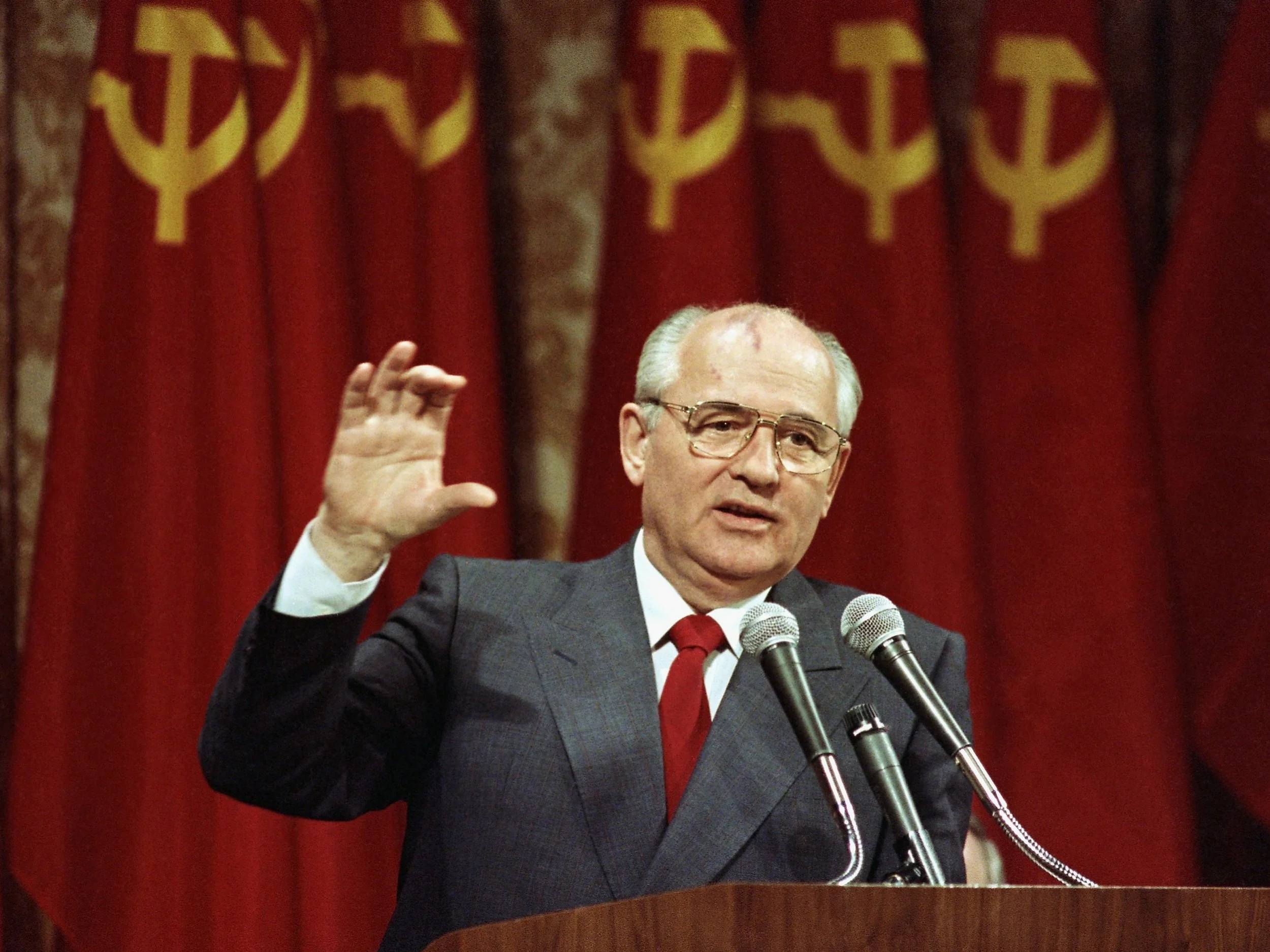
Former Soviet leader Mikhail Gorbachev
I know nothing of what it means to lead a nation. But I know completely what it means to lead men. I know little of what true public service for a country looks like, but I truly know what it means to serve an organization that bestows responsibility, disguising it as a gift. I hold little in common with the Soviet Union. Still, I know all too well the weight of systems that lived for years before you were even a thought and require of you defensible direction when they were born through haphazard need and are now defined as resolute.
As Gorbachev’s illusions were destroyed, as he saw the unity fall and his ideas melt into the concrete like all the hopes and beliefs that he once crushed, I know that he felt both overwhelming sadness and relief. His own solution was his downfall. His opened gates; the light he let in was the thing that burned it down. To create in certainty is to birth ambiguous ends. The truth, in his hands, was no different than a man committing suicide. His sadness for the work, for the idea, for the belief that yes, the Soviet Union could rise, that yes, it could be strong, that yes, her people could support it and themselves and make for a better tomorrow. Because that is what he believed, what his forefathers believed, what was told to him, and what he preached: that this is the way, and the only way is through. They could and would be better because they must. It had to be, and so it would be.
But it wasn’t. It never truly is.
That was the beginning of the end, the dissolution of his love, his life’s work crumbling before him with the decision of one man who himself, in his own way, would see that same dissolution, that same sadness and relief, all in due time.
That relief especially felt like the weight being lifted from one’s shoulders, from your heart, from your soul. That it has ended. Your time has ended. You can go now. It feels good. It felt good, the realization that you have little control, little say in how it turns. And as it turns, your story must change, must evolve, because how else is one able to survive in such a thing?
As the first organization lifted me up, so did the second with that white, sickening, beckoning C. Captain, it claims itself to be, but it is a trap, a cruel trick of the cycle, of the need placed upon you by those around you, those beside you and above you, to commit to your service as rightly as you are supposed to do. The wheel stands before you like an obelisk, asking great things of you, expecting great things of you, as the force of faux gods pulls and yanks your shackled hands, connected to chains linked farther than you can see. Sister, I feared it because I never saw it, never wanted it. An anxiety that comes in a wave like the crashing sea, one that I had but my body never allowed me to truly conceal. A confusion and authority I never truly believed I, or anyone, deserved. A beckoning, a wanting of answers, of what to do, how to orient oneself, of how to walk when I myself have to walk as well. Sister, it is a cruel trick that it plays on you. One that makes you enjoy it somewhat, that tells you it is an honor, that you should be proud to have been chosen. And I was truly too proud to have been seen in such a way, to be raised up, to be needed, and to be required of more.
The first taught me how malevolent such a task is, and I realized why there were so few of us. The second revealed to me just how little say, how little choice one has in the face of the organization that sits as a god and speaks of its need for you. So you do what is required of you because the only way must be through.
I believe Gorbachev sat with this until his death: that the cycle was over, that it had ended for him, that he had done all he could do and it was out of his hands. The plotting, scheming, policy, it was over. Now he could be Mikhail instead of Mikhail Gorbachev, head of the Soviet Communist Party. Something so simple, I find, is the very reason for anything: to become Mikhail again. A man I never knew and who would most likely detest me, and me him. In that same moment, I find him happy. In that same moment, I see more than a brother. I see me. It is done with him. His cycle is over. His wheel can stop, his revolution. As if to fade into the foreground, the quiet hum of relief brings him close.
As the Iran conflict continues to push forward, I think the same of both sides, filled with people I am far from alike. Both sides are filled with sadness. One side mourning a lost leader in Ayatollah Ali Khamenei, who once held it all together, now able to find some relief, finally, I imagine. Calling for the death of President Trump during their procession, and him needing to continue the bravado and the façade that he continually keeps. In his sadness, I see it. An attack on commercial U.S. ships that could foil the whole deal and throw everything beneath it, but they still march toward that resolution, toward that endpoint of the nascent struggle. A struggle that must happen on both sides because they feel it is required of them. Maybe it is. Maybe they have to continue with their rhetoric and their beliefs and their power struggle, and that ever-present, omnipresent, vague fog that says we can do more. Maybe they do need to do it.
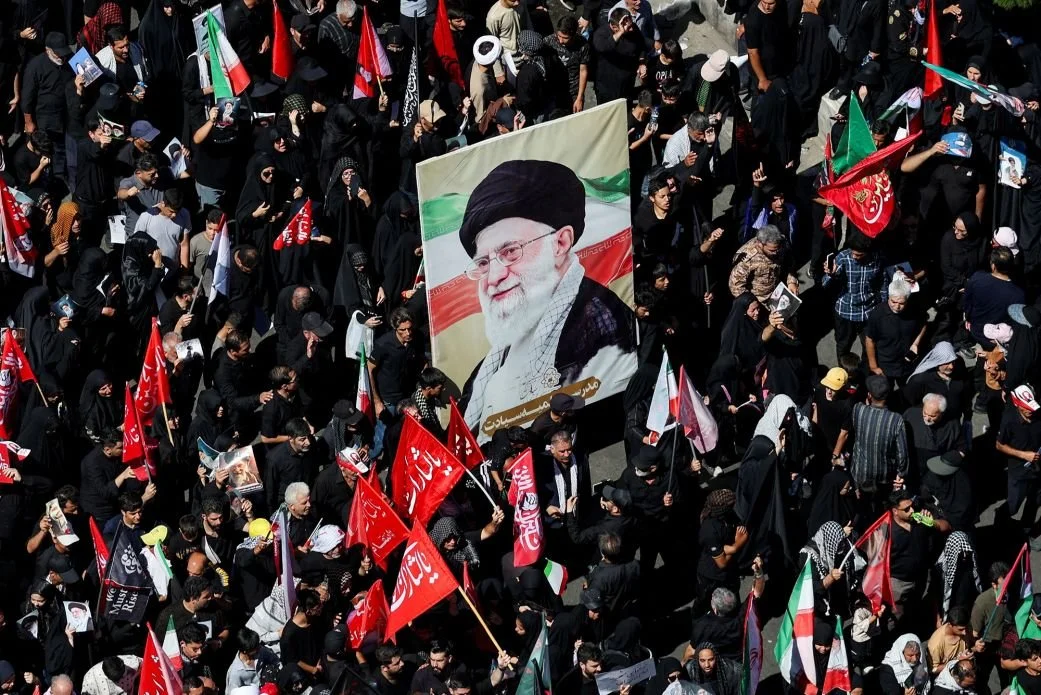
Iran mourning Khamenei
Two nations of which I asked only peace and thought I held no true love for, that I only saw their sadness. You helped me realize that the wheel doesn’t grab you because it is an irrational being. It grabs you because, in its request, the pursuit is noble. Like so many before, so many brothers and fathers, sisters and mothers, its promise is the lighthouse in the distance, the relief from the wanton agitation. Life, liberty, and the pursuit of happiness. A noble belief, one that can be stood upon and believed, and rightly should be believed, that so many fought for; you taught me that. You taught me that it may not be what we chose, but so many before have made it ours. So many before have been required to give more, and so they gave it without question.
I wonder if I was childish the third time that blackened C called for me. That the cycle hauled and extracted more of me. That if one is beckoned, then one must lead. Then you must conjure an answer if there isn’t one. You must make tangible the intangible. More and more is required of you. Maybe the wheel is correct in its asks, sister. All those things that were asked of me, I did them. I did them like it asked, to success, though not the same, I am sure, as before. Sister, I just thought it would feel right in the doing of so. Shouldn’t it have?
It supplants itself with stories. Stories, after all, are needed within an eternity of demand, as it is Virgil through the many layers. More and more stories of what the purpose of the strait is. More stories of how Iran is to carry on and why, how the United States is to carry on and why. Stories that are every individual link in the steel chain. Stories they created, stories others told them, some they need to believe because, as they trip over each pothole, how else could they stand up if the chain had continual slack?
Humans are indeed irrational and completely rational beings, are they not? Walking with shackled hands with complete faith that this is right. Like all other interventions, this is right. Like all other battles, this is right. Like all other conquests and murders, this is right. Like all of those before me, this is right. The shackles are merely your stories, connected ties that bind, ties that are forged carrying one thought that says, “This is right,” as that vague figure in the fog drags you along. They are all sad, every last one. Some more than others. Some caring less or more, but all being brought into line, side by side, not repeating the same song, but for some reason carrying an increasingly familiar rhyme.
I don’t know if you remember, but those times with you away from it all felt like a sad imitation of that relief. We watched Boyz n the Hood, and you told me about the Soviet Union and Boris Yeltsin and Mikhail Gorbachev because you were learning about it, and this reminded you of that. As I asked you, “What else was he supposed to do?” you responded with a look, one I’ll never forget, one I’ll never tell. But the look was enough. It was worth more than this, if I can be truthful. Sister, because I lack your esoteric talent, missing that same ebb and flow, I write this saying that I understand that look now. I understand that relief. What was lost. What was given.
I write this confession to you because I find my sadness again. I am back in that same void, the same Furies staring at me in the mirror, me staring back at them. I write asking for answers I hope you have, but I’m okay with a simple response. Because the ask of me is direction and belief, a need and tangibility to hold what cannot be held, to see what cannot be seen, to do what no one else has done. I see why my brothers before were all broken by the wheel and why I will be broken by it too. What man, what being, irrational and completely rational, would give such things to people who ask for them so badly? To people who will listen and need them. What good does such a thing do other than satisfy that waking need?
Sister, I know you have wisdom, medication against that bleeding star, shining, burning, that illuminates and squeezes the dark. I thought I would beg more, plead more, but like my realization, like every golden calf that has called for me, I know it won’t amount to much. It has little use when faced with such a thing. I write to you knowing my end, knowing what I face, claiming to be captain and master of a tumultuous fate and malignant soul. Sister, I fear all the fears that I fear, and still, I fear more than their total sum. As I am dragged in the macabre dance between pothole and jagged step, links spanning farther than the hushed black ocean and shackles that rival Atlas’ own burden, I take each step knowing where that relief sits. That I must now walk. I must make the intangible tangible because this is a violent world and a world that has asked me to take the next step. A world that asks of me nothing that I want, and maybe such a requirement is valid. Maybe such a thing should be heard. So I should make it real, make it so, like all the others before. Walk because I am asked to. Answer because I am asked to. Give because I am asked to. I may not have complete faith, but I must build and walk, even though one can give and shout with certainty while my tired eyes and lips shake with mounting dread, something I know one cannot lead with. Leading in certainty is a falsehood, but it is asked of me. So with every step, every decision, I need to make the best of it, do the best that I can, see it through, since that is the only way, and make all those impossible things possible as the many before me have. It is noble, it is just, and with love and faith I will see it through. I am proud of the belief that they found within me. I carry it happily knowing all that will come from it. It will break me, like all the others. Of that, I am completely certain. But, sister, in that carousel, as it swings round and round like the ever-spinning wheel, the torment I pray increases the peace; it is there I can find myself happy.