Happy Birthday to Ya
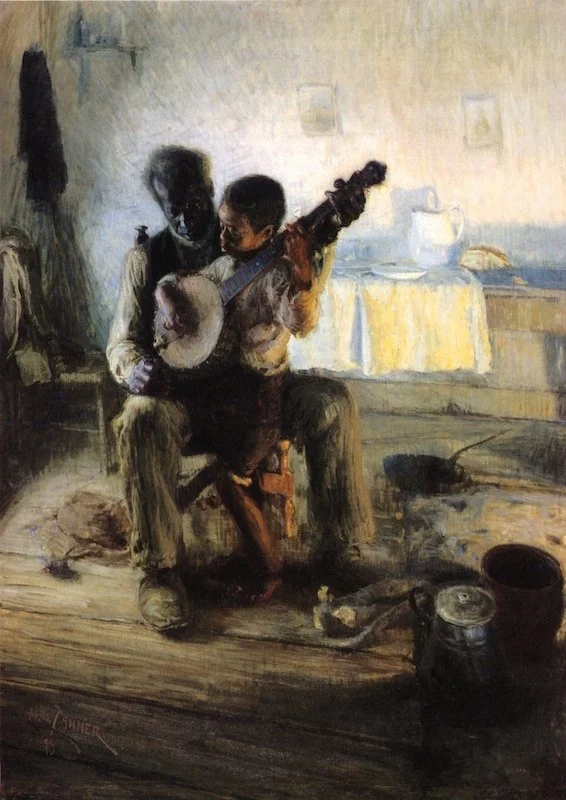
Henry Ossawa Tanner, The Banjo Lesson
The long kiss goodnight or the birth of the brightest sunshine. That fateful day has that feeling for some reason, and no matter where it falls on the spectrum for me, no matter how many candles and gifts it bears, a birthday has always been odd. It is a day that has been appreciated, yes, and I am thankful for the many wishes and the constant love people give you on that day, but for me, celebrating who I am has never been a priority as the person born on that day. In truth, until recently, noticing my age increasing was the least important thing going on. There was always something else at play, with the main and most important thing being ball every year except this one, and this is where the limbo knocks on my door, but not as a surprise but as an invitation or an offer to finally come outside and join the rest, as if an unknown actor had held its hand, guiding towards a new direction. “Is that fulfilling?” I ask, standing in the doorway as if salt lined the doorframe. “Will anything change if I do it as others do?” “Is celebration for me?” Is that what a birthday is inherently: a celebration of a person’s life and the day they were born and graced the world with their presence, as if it held the significance of posting the 95 thesis or crossing the Rubicon? It is a special day, yes, but is that special worth that much? Planning getaways, hosting parties, having surprise parties thrown for you, sashes, and the gambit of other offerings that come with birthdays. Are all of those things really the point of the birthday? It has always just been the coming and going of epochs, which tell me what is to come and what is to pass, but even then, is that right? The more I question, the closer it gets; there are glimpses of a figure behind the warden, maybe the owner of this makeshift prison—a prison of quotas and dates, filled with timelines and determinants. Unlike a curmudgeon, there is no need to put down the people who treat their birthday as such, but for myself, as I quiver in the doorway, faced with the smiling faces as if stasis had made them sign contracts, the least I can do for this moment in time is look at it. After all these years, maybe it will show me something I have yet to see.
The idea of a birthday is fairly new to society. There were birthday celebrations for figures like kings and pharaohs, but for common people, if they even knew the day, they did not celebrate it. It is believed to have started around the 19th century with kids. The most damning thing is that it came as families began having fewer children and living longer. Instead of being seen as a labor force and a means to an end, children were now seen as genuine parts of the family. The 19th century also brought industrialization and brought the concept of time closer to people. We now take for granted how closely we watch clocks and plan things to the minute, but before, people rarely had clocks, and even when they did, they were often inaccurate. As time developed, so did our concept of time, and its passing developed alongside it. Time and age separate students by grade; they inform doctors of potential or growing health risks; and the once-foreign concept took form in a realm where it was seen as a shadow, as if to give form to the voice that whispered and has now been seated before the masses as a stringent god. Like many things in history, when new developments come, people look down on them. With birthdays, people believed it would create self-centered, selfish, and materialistic people, turning their attention to themselves and away from the Lord, and give credence to humans who believe that they deserve more, that they are better simply because they have reached some milestone that, in the span of time as we know it, has just recently become a milestone to pay attention to.
Maybe I am one of those curmudgeons; maybe I would have been one of those people arguing to stop celebrating birthdays, like some town crier on a stack of newspapers or a random assortment of wood in the town square. Like all things, there is truth in the argument because birthdays, in large part, have become self-centered celebrations. They focus on the individual and their growing age, the ticking clock as time moves forward, and a deeper attachment to life. As it keeps growing, time starts to lose its sense of friendship and becomes a pariah in people’s lives. At first, the birthday is a sense of what is to come: the beauty of life and all it has in store for you and the dreams you will accomplish, but as you begin to reach that turning point, most likely around twenty-five, is when things begin to change. Most people are out of college, in the real world, and now life is decided by you; it is up to you, and the clock keeps passing without regard for how you relate to it. The celebration then becomes a comparison with those your age who have done more or less in the time you've had so far. That is what the birthday eventually becomes: down the road toward the singing twilight, as time calculates and sits back like an accountant, you either feel as though you belong or that you have taken a misstep somewhere. Somehow, as you stand in front of them, you tell time that it must have made a mistake, that this cannot be right, that I must have got off at the wrong place. Time, you are my friend; look at everything we have done together; look what I did for you. Time sits there and, for a moment, drops the receipt from its face and stares at you with the stare of a stranger with something more important on its mind. Time then motions you to leave or go to the end of the line because Time has much work to do, much more important things than to care for you.
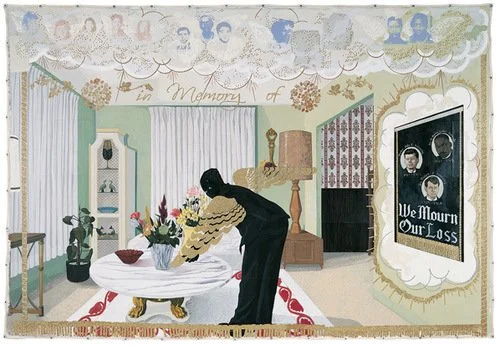
Souvenir I by Kerry James Marshall
We argue with time so consistently because, as present as it may feel, it is outside of us, and as strong a grip as we have on it, it is vapor in the crease of our hands. Many people have tried to define time. Is it a flat circle? Is it a cube? Aristotle says it is the measure of motion in respect of before and after. Kant believed it was a cognitive framework, and that we cannot experience the world without structuring our sensory inputs through time and space. St. Augustine saw time as something that exists purely within the human mind: our memory is the past, our current attention and perception of the world is the present, and expectation and longing are the future. If we can all agree on one thing, it is that time exists to us and, for some reason, even before we could tell it, it has importance to us. It is the tool that we use to orchestrate and determine meaning within our lives. Past successes and failures, upcoming dates and projects, relationships, births, and deaths all exist within the framework of time. For us, the shadow behind the warden becomes the obelisk towering over us, directing each of us like performers in a play leading to an end we will never see. In that, maybe it makes sense to celebrate the birthday as it grows closer, as our existentialism sets in and the universe begins to confirm how meaningless and small we are; we can only celebrate ourselves and our contributions because the blip on the radar that we represent is a truth that we shudder to look at. It is our violent revolution and a revolution that taxes the world with blood and bone, demanding our freedom as recompense for the fallen.
The saddest thing about a violent revolution is that it never works. No matter the people, country, or age, a violent protest is usually met with retaliation in kind, even if the violence loses its physicality, as Haiti can attest. We cannot go back to the times when birthdays were not celebrated, since we live in a post-celebration, time-bound world. The concept now lives eternally in our recognition, and no matter what we choose, it will stay there. So the only logical conclusion is to understand what a birthday is. It is the birth of a child into the world, leaving their mother’s womb. That is where we see what this thing really is. After the birth comes, traditionally, the care of the mother and father, then the help of the surrounding family unit. As you begin to walk, grow older, and step outside the family unit, you meet friends, teachers, and coaches; each one you take from and build upon the animatic you represent. From that come moments in the world and many things you learn, all making that sketch board motion and anticipated animated beauty. You see, the celebration is mutual because you did not come here, nor will you leave on your own. You are a person in this world, and in this world we are nothing without the people who help us learn and grow every day. When you finally leave and have that last birthday, even if you believe you are alone, someone else cares for you, whether they are here or have already passed on; that is what it means to be human. To have your life defined by the finality of our existence. With the largest grin, I am the curmudgeon who yells at you to stop celebrating yourself and the people around you because, as great and beautiful as you are, the people around you have made this something worth celebrating. You are not self-made; you are not a being of pure will and determination. Simple chance, luck, and grace have brought you this far. A blessing that, out of the hundreds of millions of sperm, you found the egg, and nine months later you came to be, but even in that conception you had no part in it.
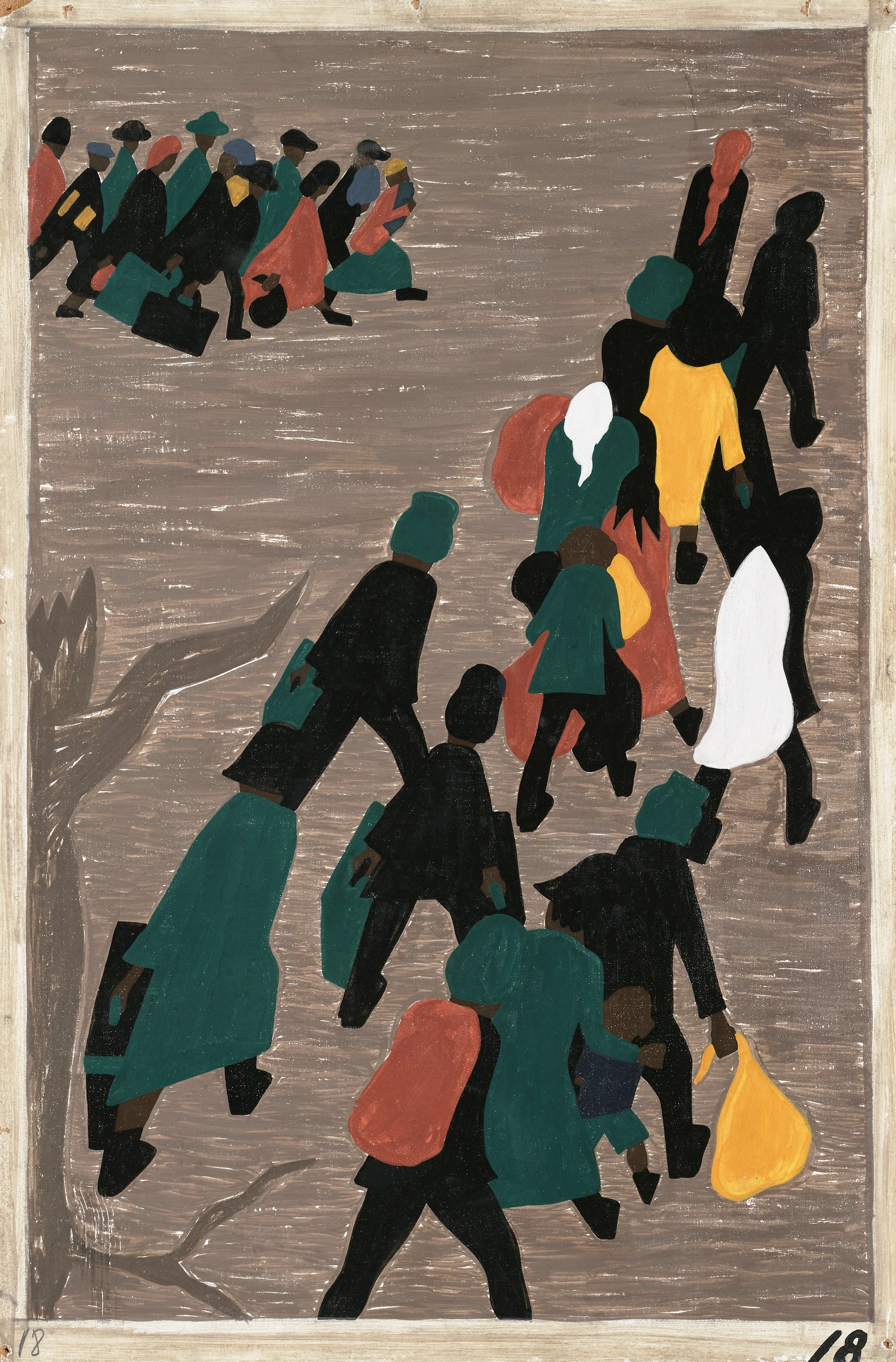
No. 18, The migration gained in momentum by Jacob Lawrence
The crowd is beginning to disperse, but the curmudgeon is not finished. Ebenezer Scrooge has one more thing to say. He steps down from the wooden box, takes off his hat, and looks at the men, women, and children before him. With a shaking voice, he asks if they have ever stepped in the same river twice. They roll their eyes; some say no, and a few say yes. Scrooge tells them that yes, we are constantly changing, consistently evolving as people, like the water in the river; the river’s identity remains the same. As Wittgenstein noted, a river like us is defined by its surroundings and communities. Its rules, banks, and how we identify it with our language; we do and can step in the same river twice and be the same man. As this river flows and flows, weaving and snaking, we see it is a flowing vein of interconnected occurrences made up of events. Each event identifies what has happened and what is happening now. The curmudgeon takes a few steps closer and says that the real revolution is throwing the day away completely. That one day a year is not enough. It is not simply a celebration or even a reflection of those who have helped us come this far, but an act of service. Every day is a day to share this love and care with someone you know or someone you have never met before. Your birthday was not the beginning; for that was long, long ago. You are here in the perpetual present. Scrooge stands up straighter and tells them this is not a story of new chapters, with each year being a stop until the book is complete. The story is built outside of structure itself. You are in the doorway still because you think that formation of wood and the bed upstairs represents a home that is a beacon and a set and designed point and place. Scrooge asks you to take that step and walk past the salt, walk past the frame because the world itself is your home, not the cause of your mounting stupor. Step outside and learn about the trees and why they are here within your neighborhood. Learn the design of the block and the houses along it, and what made people before you create it that way. Look to the sky and see the birds in their pattern, and why they chose that formation over others that once ran long past, and how we copy them today. You see your being is greater than a day of celebration or reflection, so treat it as such. It is a being born from love and through service, and in this story, with your time to write the next couple of sentences, respect those who came before you and try to understand what they were saying. If they misspelled something, correct it in your line; do not go back and erase. If they wrote a beautiful sentence, connect it to what you will write in yours. The revolution, this birthday, it is all a farce, he says, walking past the crowd. Every day is filled with history, learning, and service, and when you hold the pen in your hand as it is your turn to write the next words, it would be a shame if you never took that into account.