I Just Want to be a Waiter
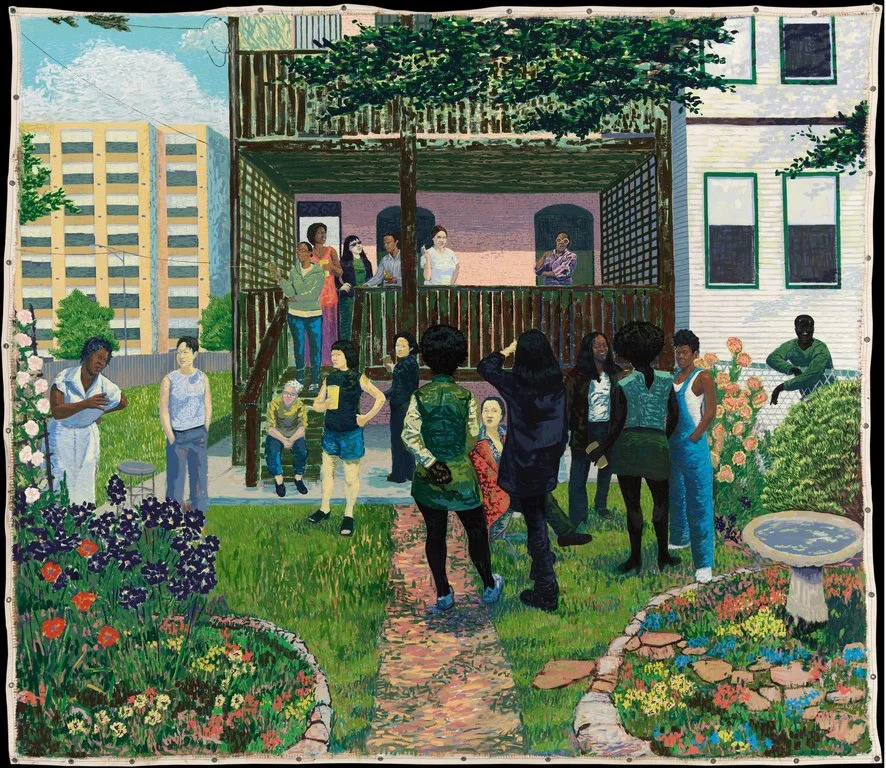
Garden Party by Kerry James Marshall
I like to go for walks most weekends. Sometimes in parts of Jersey, but most of the time in random parks or on the streets of New York. New York is the most interesting, but they both have similar feelings. New York just has this certain miasma that it basks in, thrives in almost, that you can’t explain. It affects everyone and everything that is enclosed inside of it, kind of like a welcomed curse or blessing from the forgotten marshlands underneath. Two times specifically come to mind when I think about it, both in New York City in Central Park. I love that park for It’s beauty. It’s huge, almost incomprehensibly so. I take different paths and travel to different areas. It kind of reminds me of the Library of Babel, but in this case, it is filled with people rather than endless books. Lovers, families, dogs, cats, birds, rats, artists, pickleball, kickball, and anything you could think of. Everyone in different or similar areas, enjoying each other and their time, as the runners seem to evaporate and reappear, like that of death and reincarnation, with every turn of your head.
What sticks out to me, and what has always stuck out to me, is how lonely the city is. I can be this way sometimes, but Open City by Teju Cole confirmed it for me. The longer I’ve lived here and the more I see, I can’t help but see anything other than a vibrant void. For all the laughs and cheers and coffee shops and events and functions, you have more homeless people who, at one point, used to experience and have the same things, now lost, like an ever-present future or a hideous past that won’t leave. Treated like some other, but at one point in time, they were no different from anyone else. In truth, they still are the same, just in a different predicament, one harder than ours, but they are treated worse because of it. They are outcasts because society failed to offer them what all deserve to be offered. I have even bought into the collective agreement to look past them. It is an enhanced trait in this city, but societally, we do it in all human enclaves. It bothers me how I can just walk past a person as if they don’t even exist. My only rebuttal to myself is that you walk past people every day, on the go and in motion, so is walking past the homeless even different? Who can help everyone or acknowledge all the people you pass each day. Then comes the second rebuttal: You do in Dayton. You walk past someone and give a smile or a head nod to those you’re in community with, so what makes it different here? Is the volume of people really an excuse? There is no chance in this city that, if I tried to interact with everyone I passed, they would interact in kind. Maybe I am blowing this out of proportion, making it too big of a deal. Still, it irks me, a headache that won’t escape me, because these are people, human beings, who deserve the small interactions that make us human, the need for connection in our individual journeys. They used to sit in the park after work with their friends and family and discuss their dreams and the world. Maybe they treated the homeless better or worse; who can say? What can be said is that homelessness is a failing on our part as human beings. The need for more has taken away the beauty in front of us, and it is consuming each other. We use people as a means to an end rather than attending to and ministering to one another. That’s the most confusing thing about it. Those people, who most likely did nothing wrong, lost a job due to a business’s greed and failure, lost housing due to the system’s misjudgment and lack of care and love, or had a mental health issue deemed unimportant because they could not pay for services. The people who need service and love the most cannot receive them because it is about acquisition and payment, not love and care. Like Tim Johnson, hurt, sick, and afraid, wandering back into the neighborhood only to be met with bullets and fear. At least that’s how they’re treated. Like ghosts, memories of a city past and long since forgotten, another thing to build upon.
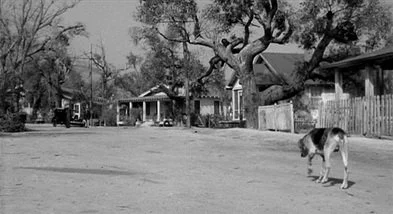
Tim Johnson from To Kill a Mocking Bird (yes the dog)
Although what tells me the most about it is those people in the park who aren’t them. The first instance was a man practicing what I can only guess was some form of karate alone. I have no clue what he was doing. It kind of reminded me of those people you see acting like they have unlocked the ability to use their telekinetic spiritual powers, real earthy sorts. But I sat on a bench and watched the dogs and families, and I also watched him.
He just kept practicing these kicks, and I just thought, how long can one man practice a kick? A Bruce Lee mentality: to practice one motion a thousand times rather than a thousand different motions. For a second, the vision came to go up and ask, but I quickly decided against it. I still can’t get him and those kicks out of my head. What I do know is that he must have loved it. It had to have mattered to do that in the park all day for Lord knows how long. The saddest part is that people probably didn’t notice. That’s what makes me feel a phantom pain of another, long since passed, but still, their soul weeps from the thought. Some looked over and said “weird,” among other words, sure, but who really noticed him, saw the moves, saw him talk to himself, get back up, and keep working? If someone went up to him, if I went up, he might have done a few more kicks and flips and explained the technique and what got him into it. He could have told us off and said he didn’t want to be bothered. He also could have given us some inside baseball on the little intricacies of how to turn your body, where he knew he was messing up, what he was aiming for, and how important it was to him because he doesn’t get to talk about it often. I could just be speaking vicariously because I know that feeling and care from my past life, but I saw him. It makes sense to me. Maybe I should have told him. Maybe it would have helped.
The second was a time when I walked through the park alone, and I noticed an older man sitting by the lake that I had just found on this visit. He wasn’t doing much, looking through his bookbag some, reading at other times, but mostly just sitting. I thought it was strange, but hey, I’ve seen much stranger before, so I just kept walking past. But something compelled me to stop and say, “How are you doing today?”
He turned around slowly, like a phantom that was inexperienced with being questioned, as if there were a taboo against acknowledgment. However—and I’ll never forget this—he smiled and said, “I’m doing well. How about yourself?”
“I can’t complain. I’m enjoying the day. Is it good?”
He looked confused, then remembered his book and said, “Oh, this? Well, yeah, yeah, it’s been pretty good. I just started it, but it’s good. Well, interesting, I guess.”
He laughed a bit, and I said afterward, “Well, I hope it gets better than interesting.”
We laughed, and then we said our goodbyes and went about our days. He stayed by the bank. I went to cross the bridge, and I never saw the man again. I never heard his name. I can’t fully remember what he looked like, even now. I just remember those few exchanges of words and our small interaction, our passing of understanding, and the conversation that is a handshake and a hugging of the soul that says, “I am here.”
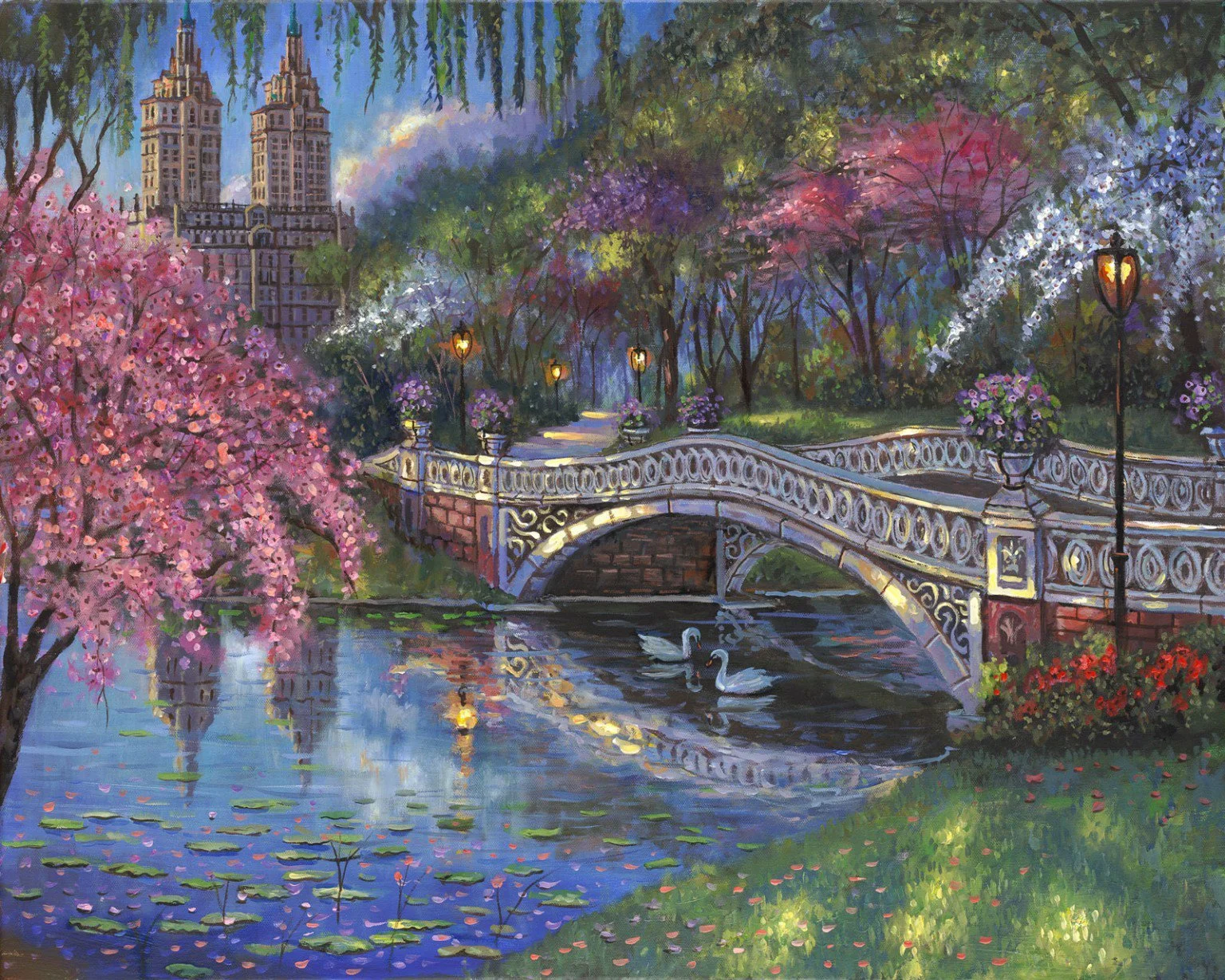
Bow Bridge Blossoms, Central Park by Robert Finale (the bridge definitely doesn’t look this good, but you get the point)
I admittedly still don’t do this often enough. You’d think I would after that. It is something that is so regular, especially back home in Ohio. It’s just what we do. Maybe it is the miasma clouding me, me succumbing to the collective movement of the city. I’m not sure, but still, I wonder if I was the only person who asked him, if anyone else had talked to him before or after then, if he had a family, if he really did think the book was interesting, if he enjoyed the day, and so on. I don’t have those answers, but what I do know is that the time we spent was small, brief, and infinitesimal compared with the vast amount of time that I have left. But it was time to remember and worth sticking in my head, which contemplates so much. Two men, one old and one young, doing what they love to do and acknowledging each other doing it. What I couldn’t give another, I gave to him, and I should give to more. Something in me still just detests the plague, the disease that has fallen over the city, over myself. Hypocritical, sure, but I just wonder: Am I the only one? Does anyone else see this? I understand that bleeding question and the ferocity with which Charles Riborg Mann and George Ransom Twiss wanted an answer, asking: If a man were to scream in Central Park, would he make a sound?
I was reminded of this days ago by a J.K. Simmons video I had seen earlier this week about his time as a restaurant waiter. He was being interviewed at the same restaurant, and he reminisced about a moment when he and the other waiters were smoking cigarettes and talking to each other. Many of them, young and in their 20s, said they were actors, dancers, and directors.
One waiter, Regan, said he was a waiter. This caught the group off guard, and they said, “No, really. We know you’re a waiter.”
But Regan went on to say, “I like this. This is my career. I want to make more money and work at a steakhouse, but this is what I do.”
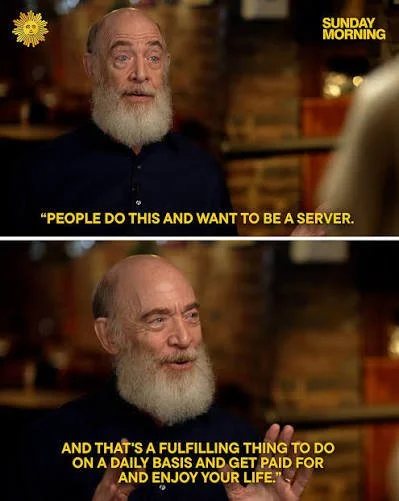
J.K. Simmons interview in question
It put a smile on my face hearing this. I’ve always been a be-where-your-feet-are type of person, and I’ve also wanted no less than what I could imagine and worked toward it every day. But more important than that, since a young age, I’ve always lived with the belief that if one thing is important, then everything is. That is simply how the world works. As complicated and oppressive as it is, it is an organism of many parts, and if one fails, the whole of it falls. It’s not hard to imagine the importance of a waiter. Someone needs to get the orders, someone needs to grab the food, and someone needs to collect the payment. It’s an extremely important role, but it’s always described as some gig job, something on the side to make money for what I really want to do. Regan clearly saw it differently because he saw it for what it was, for what most jobs, maybe all jobs are, and what makes them things worth pursuing and worth loving, even within the perverted state of the system.
There’s bad service, and there’s amazing service. All bad service can be different, but all amazing service is the same. It’s the feeling. It’s a know it when you experience it sort of thing. That’s the most beautiful thing about a waiter. A specific time or story doesn’t come to mind, but many encounters, laughs, and services that made my day, that added to our family conversation, that brought a joy that none of us could guess would come, that woke someone up and cheered up another continue to pour in. A service worth paying extra for. Financially, for a restaurant, that is what brings a customer back; it isn’t the food, it’s their people. More importantly, for the customer, receiving feelings like that changes your day. To have the ability and to want to change someone’s day that’s why Regan must have wanted to be a waiter. Important in and of itself, yes, but to give and share love with others, to make such a foreign and chaotic place feel like the doorstep of an ancestral home that’s what it’s about. As much as it takes to brighten another’s day, you brighten your own spirit. It’s the sort of teaching that only strangers can give to one another. Simmons, at the end of the video, said, “Regan, I hope you’re either retired or at the fanciest steakhouse in Manhattan.” After hearing those words for Regan and all the others I came across, I couldn’t agree more.
In a city such as this, people like Regan, like the many other great waiters, are important to have. When everything moves a mile a minute, persistent motion and working toward something, you forget the moments. That’s the hardest thing about it. Forgetting a feeling is something you can’t call the worst experience because you’ve forgotten it, so how can it be terrible? The saddest thing, maybe that fits the description: the feeling of continual search like a thirsty man lost at sea or a hunger-stricken man wading through the desert; I can’t help but wonder what it felt like the last time I played with toys. A fundamental, foundational thing, for it’s most likely one of the things that has made me who I am today, especially when my brother used to play with me. The storytelling, the laughs, the surprise, shock, childish horror, hurrays, and oh noes the world isn’t worth the trade for them. My brother must have felt the same feelings, although with different emotions. To see another person happy and enthralled is arguably the better perspective, and one he handled well with love and care. To orchestrate the stories, see what worked and what didn’t, how I followed along, and what I did and didn’t understand. It was an equal love and participation, giving to one another and waiting for each other, in a sense.
I just can’t remember the last time. I wonder what it felt like. Did I think I would play again? Did I know this was the last time he and I would sit down and play together? I can think of all these things and think of them as I am now, but it doesn’t hold any worth to the boy who was there, the boy I seem to have forgotten. It looms over me like an anger-filled poltergeist because it makes me know that I took that last moment for granted. I can remember other last moments, other last times, clearly and verbatim. That one I’ve forgotten. You might say people forget things, but no, important things like these stick with you your whole life. The very recognition that I forgot tells me that, at the moment, it wasn’t important to me.
I’ve never asked him if he remembered the last time, if he had thought he would create another story or pull the toys out again. Selfishly, I hope so, so I can ask him and, in that time, see the younger me again, surprised or happy, sad or mad following a story I had loved for so long. To know that I really didn’t take the last time for granted.
When thinking about the importance of those waiters, of Regan, of talking to the old man, and watching the other, of my many roles in life now, they touch you and mean so much. They are all worthy pursuits for others and for yourself. To not be present, to be in perpetual motion, and to not remember the last time something happened is one of the saddest things that you can experience, and I have. It’s not hard for anyone to think of the feeling or imagine if they forgot something. Momentous ambition in its importance seems to be found only inside the miasma, which suffocates and intoxicates all inside of it. As worthy a pursuit as whatever it is that you chase may be, be where you are because of how much it will mean tomorrow. For the memory you can share with your brother, the story you can tell to a friend or your kids, and, most importantly, the reminiscing you can do with yourself. Something I desperately wish I had as the storms shake a dilapidated boat.
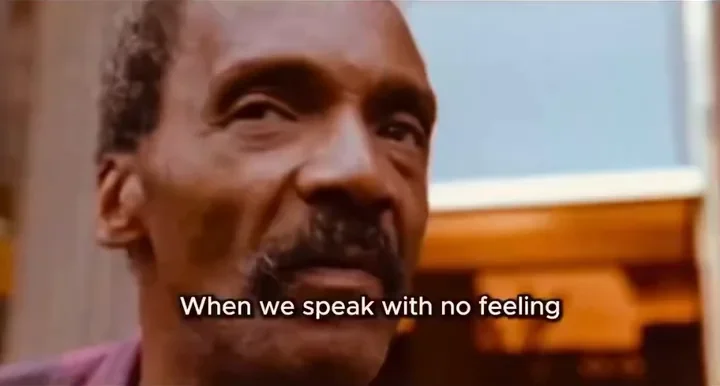
Looking for Richard (1996)
When I remembered those waiters, I smiled. The man whom I met in the park will always teach me to stop and talk to others, just to see how another may be doing that day. As sad and isolated as this city may be, in these few months, it’s reminded me of something it constantly whispers in my ear, telling me to forget. The action, the pursuit, the thing worked toward, is never really the point. It’s not the full worth of the good or the job that you do. It’s all connected in a way, and you’re always being and interacting with others. That’s the rub that keeps coming to mind. It’s all worthy because it’s all next to someone who woke up today, the same as you did. As a Black man said in the documentary Looking for Richard, “It’s about feeling.” There is nothing about offering it because it’s just there every single day. All you have to do is not turn away from it, step over it, or ignore it. Acknowledge it and let it see you every day and every moment. You may never retire at the age you want to; you may never work at the fanciest steakhouse in New York; those things are far out of your hands. What you can do in the journey amidst the fog is that every passerby you see, stop for a moment, share a few words, give a little bit; it can range from a small smile to a cry. Just remember that’s what every form of actualization is, as the titles get fancier and the recognition grows. It’s just about being a waiter.