Brass Tacks: Sacred Translation
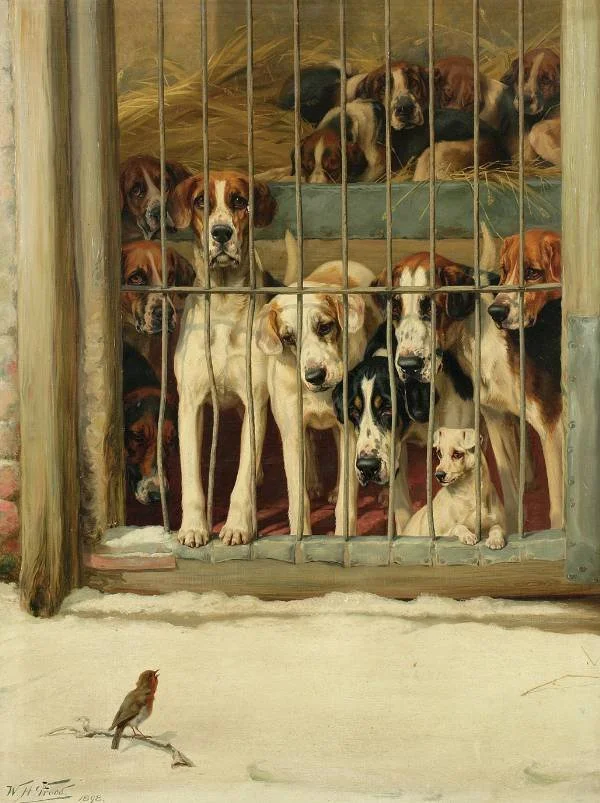
William Henry Hamilton Trood, Hounds in a Kennel, 1898
“How was today?” says the man sitting behind his desk.
“Nothing special. He was talking to his brother. Some things about a dog and some old stuff that happened back then,” says the other man sitting in the chair across from him.
“That’s it?”
“And something about translation. I don’t know. He says some things. He doesn’t say anything, but something useful will come.”
The tape recorder and the transcript are dropped on the desk. It is titled “Conversation 012-Dog.” The man at the desk opens it and begins reading.
“Max! Max! Come on, Max, we can’t keep doing this.”
Panting, tired, out of breath, and thinking about going back home. But I can’t. I can’t leave him out there alone. Running through a neighborhood I barely know the layout of, through houses and yards with obstacles and lights, with other forms of attention drawing suspicious activity that I knew about but did not really have an inkling of at the time. All to save him. At least, I thought it was saving.
“Max! Max! Stop. Hey, stop it. Don’t! Max! Come here!”
Back to a high-speed chase through the streets and sidewalks, a flashlight beaming its rays as they tumble and dive amid the night sky, laughing at me, the same as the crescent moon. Max turns left into a yard. Dips right. Dodges back left. At this point, he must be doing this for fun, like some sort of ritual. Back then, I just couldn’t understand what would make him run away, and how he always chose the best time to run away.
Maximus Decimus Meridius, better known as Max, had run away again for the twenty-fifth time, it felt like. Maybe more, maybe less, but too many. No matter the cage, the bribes, the playing, it just kept happening.
“Max! Max! Stop it! Just stay there, Max. Be still, Max. Be still. Be still. Be—”
Dive. Duck. Dodge. Roll. Grab.
Thank God for corners and tall wooden fences. He was in my arms now, the brushwood dog. As tired as I was, I was always amazed by how he’d crawl through fences, dive underneath them, jump over them. Old habits die hard, as if his function still showed itself after all this time. But we were here. We were safe. I put his leash on, and we walked back home with it wrapped twice around my wrist. Me and Max together again. Another day, another chase, another problem solved, another reunion. Bond retethered. His defiance solved.
As I looked back and he panted, tongue out, tail wagging, teeth in a grin, I imagined him happy. I knew Max to be happy.
I walked through the door back home. You had already gotten back from your search on the other side of the neighborhood.
“Where was he?”
“Caught him in the corner of a fence.”
I was too tired to articulate and needed to go to bed. More importantly, Max needed his cage. Dad walked past, looked at me and Max, and said, “This ain’t gone happen too many more times.”
Max barked, instinct or reflex. He always barked at Dad. They’re the only two that know why. Dad knew dogs better than everyone. He raised them for hunting by himself, probably why he didn’t enjoy having them now. Or maybe he just couldn’t stand seeing how we raised them. We put no purpose, no need into them. They were just there to receive and provide love. Nothing else. No passion, no purpose, no use. At least, that was what I defined as use back then.
The older I get, I think he loves dogs more than any of us, but knows what it is to raise one, what that does to both you and them. The care, sweat, and blood seep deep into the soul, never to be extracted, coagulating, forming, clotting. To break an animal for a singular use, to tear down a plethora of instincts and give it one. How now he must realize what that really meant. I think he felt that, and the only expression he had left was the distance between him and the “mutts,” purebred or otherwise.
I walked to place Max in his cage and overheard the next argument beginning. Something about Du Bois. Something about a problem. Honestly, I didn’t really care to sit in on that one. There were always others. But what stuck with me then, out of context, as I carried Max to his cage and pushed it down the hallway to my room like Sisyphus, though quiet like Jesus coming in the night so no one would notice until morning, forgiveness better than permission and all that, was the salvo in my mind with each breath. The words I heard you say:
“A peculiar sensation, this double consciousness, this sense of always looking at one’s self through the eyes of others, of measuring one’s soul by the tape of a world that looks on in amused contempt and pity.”
you were smart. I know you didn’t come up with that though. At the same time, I didn’t even know what it meant. But the thought of “measuring one’s soul by the tape of a world that looks on in amused contempt and pity,” the few words I knew, became an unshakable barrage in my ear as I fell asleep staring at Max through that cage, looking at him as he dreamed.
But of what, I thought? Playing with me in that house? All the love and care and freedom I gave him? The occasional human food? Or the night that he dashed into, tirelessly searching for or running from something that he didn’t have to? No. He must have dreamt of me.
The next day was a blur, but all that stood out were those same words playing like yesterday, and Max and me, mostly me, watching Okja. He was unusually quiet, remarkably still. Either the film touched him or he was tired. I believed the former when the truth tilted toward the latter.
Though from that day, what I barely remembered, the only time me and him connected was when Steven Yeun’s K was beaten and exiled from the ALF, and later, when he found redemption as he saved Mija and Jay, played by Paul Dano. Both scenes mentioned the idea that “translations are sacred.” On the bus, as they explain to Mija the importance of Okja’s sacrifice, one she had no say in, and the decision to drop Okja into a facility to be abused for a video to show the world, a video that may or may not change things but is paramount to the movement of the ALF, they say the decision falls on the girl who loves the super pig, the girl who raised it. Mija says, “Take Okja back to the mountains.” K translates it to, “She agrees to the mission.” Four words to describe a girl’s love, passion, and familial bond, so important to her that it is worth more than the golden pig her grandfather bought for her because he wanted her to have a life he thought was best, away from Okja. An adventure from a mountain to a city, running through glass, buildings, streets, subways, beaten and tossed around. A love so important that it is worth crossing continents and learning a new language for. A love reduced to four words to satisfy a movement that itself abuses the very animals it wishes to save because salvation is more important than the execution, the thought, the consideration, or the livelihood of the animal.
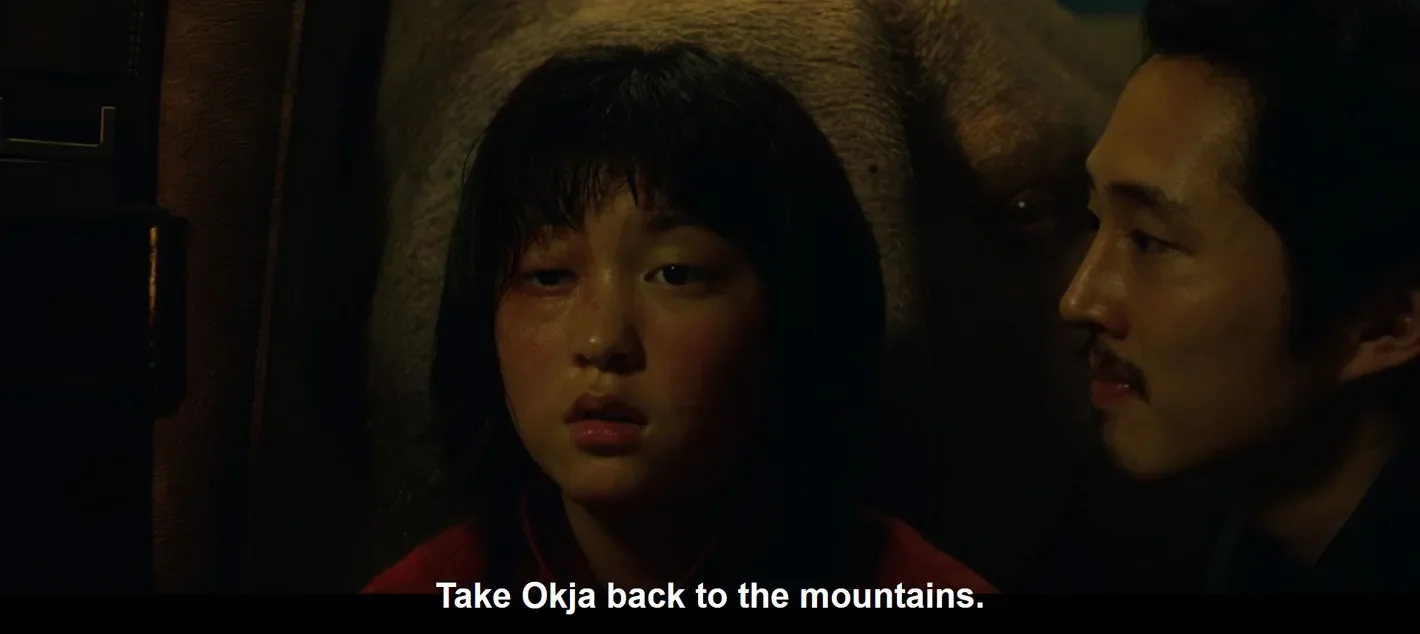
Now, this was most likely a hallucination on my part. What dog is going to remark on a theme in a movie twice in that same sense? But he did. I looked over at him, and with his head resting on his paw, he looked back toward me. He gave a small gruff, and we continued watching each time.
Back then, I remember how the film stuck with me after that night. Maybe it did with him too. That beginning scene of Okja and Mija playing and walking together, saving one another, I thought it was him and me. Our day-to-day put to film. A pig and a girl. A boy and a dog. Maybe he wanted me to see that he just wanted me to understand him. Max and me shared a mutual love, but it was freedom that he craved. A need to roam. A need from a bygone age, a time that beckoned him. A freedom that he tirelessly fought for and that I continually stopped.
For what? My enjoyment? My need to feel love and companionship? My desire to have a friend, a family member, to be there with me, to take care of, to experience things like this? But I had that in droves. Maybe it was something else. Just a dog and a boy, where the boy needed the dog more than the dog needed him. The false salvation of the streets and the night sky substituted for a cage.
But that was a feeling that needed correction. Max was wrong. There was a flaw in his computation, and I had to correct it. Stricter feeding times. Watching him more closely and keeping him near as I took him out. Marking his every moment. As if I had built a panopticon, it was all in service to him. To fix him.
These urges of his were meant to be fixed because they were incorrect, part of being like most dogs, I assumed. They all have it. Wrongs to be righted. Remnants from their wilderness needing to be tamed, torn out root and stem. So I decided that I would, and I did.
It was only later that I realized why Max might have stared back then, what I was missing, what he saw, why he eventually chose to do what he did. I saw it back then but ignored it. Only now do I see what it was.
You remember later that day, June 28th, I was studying for some social studies exam, reading about the death of Franz Ferdinand, the catalyst to the First World War. It reads like a comedy sketch. Failed attempts, and then he happens to drive by the last assassin and is unable to be saved from his own vanity because of a suit that is sewn together and slipped on. That same day, five years later, the Treaty of Versailles would be signed. A treaty that would eventually be the start of the next war and bring about the hegemony of the United States and its power to cause and solve problems. All in the name of economics, profits, exploitation, and intervention to supply wealth.
With the MOU signed, it seems as though the ability of the United States has faltered in those pursuits since days past. Maybe because the people of the country have grown wiser, knowing this is a war lacking in true purpose and sold like snake oil. Change the Iranian regime and destroy the nuclear intelligentsia. There was not nearly enough political will to achieve it, and in truth, not a goal that the administration cared to achieve.
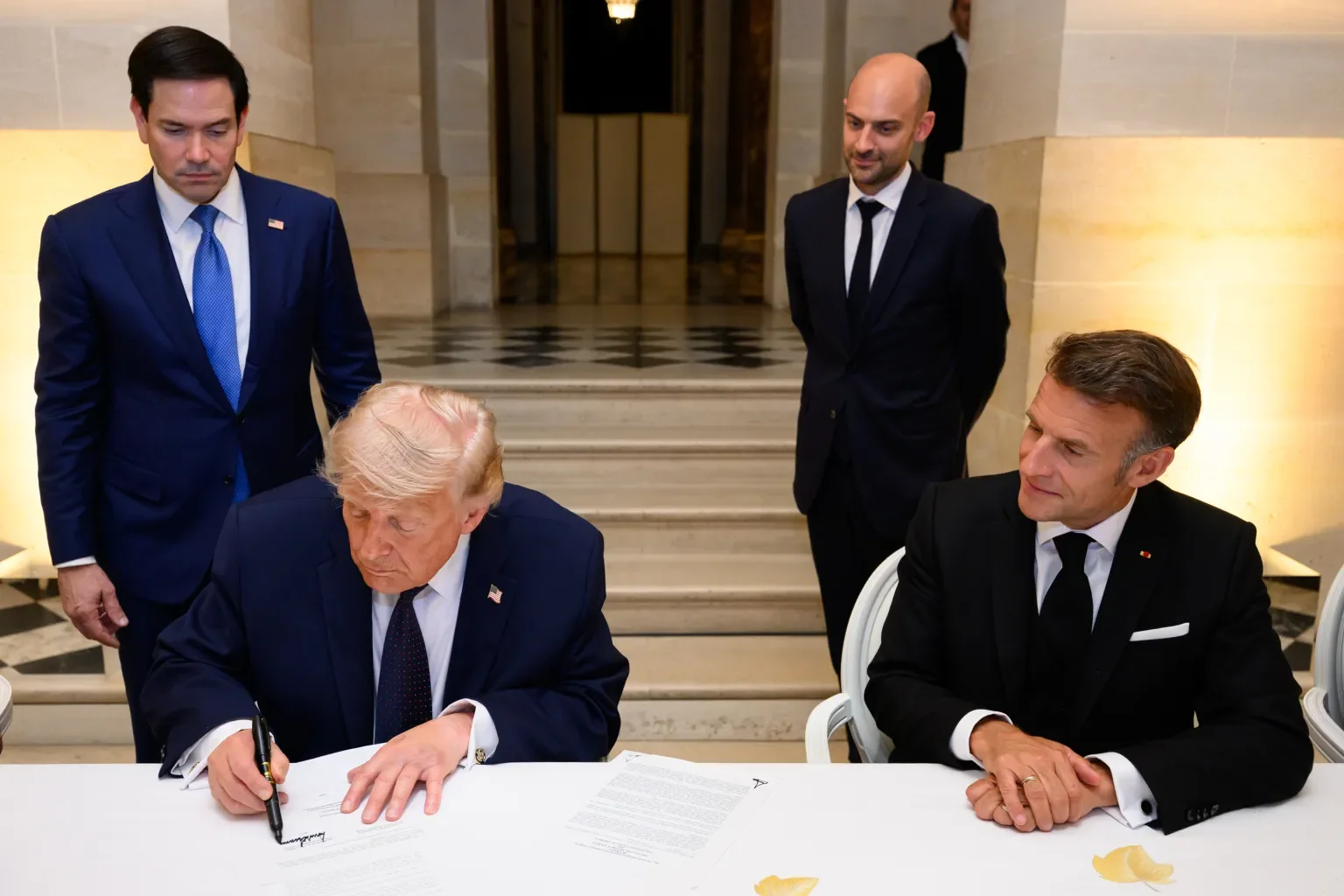
Trump signing the Iran memorandum of understanding at the Palace of Versailles
So now the MOU gives investment from surrounding Gulf countries to Iran, revoking their rogue nation status, another way the United States creates a problem, and giving them full understanding that they control the Strait of Hormuz. Now they are well on their way, most assuredly, to developing nuclear weapons.
As the Treaty of Versailles looms over, I can’t help but think of the Germans and what came after. Atrocities far worse than anything committed before and since. But as I lay here, did no one think of the retaliation that would follow the solution to the problem? Woe to the vanquished and hail to the victor, a tale absent of absolutes and filled with brimming anguish to follow. The Germans in that house of mirrors, rage and disgust reflected on them, forced to sign away significant amounts of what they had. I can’t help but think now that those countries, like me, had no care. I can’t give Germany any love for their past sins or treat them as some helpless child, as they are far from it, even before World War II. But when pushed to the brink, battered again and again, a war lost, morale waning, death surrounding, people taken, and a depression soon to come, that was the final bolt unscrewed to let the vile sludge of man seep into their hearts and hail a passionate pursuit of the cruel infamy of the Third Reich.
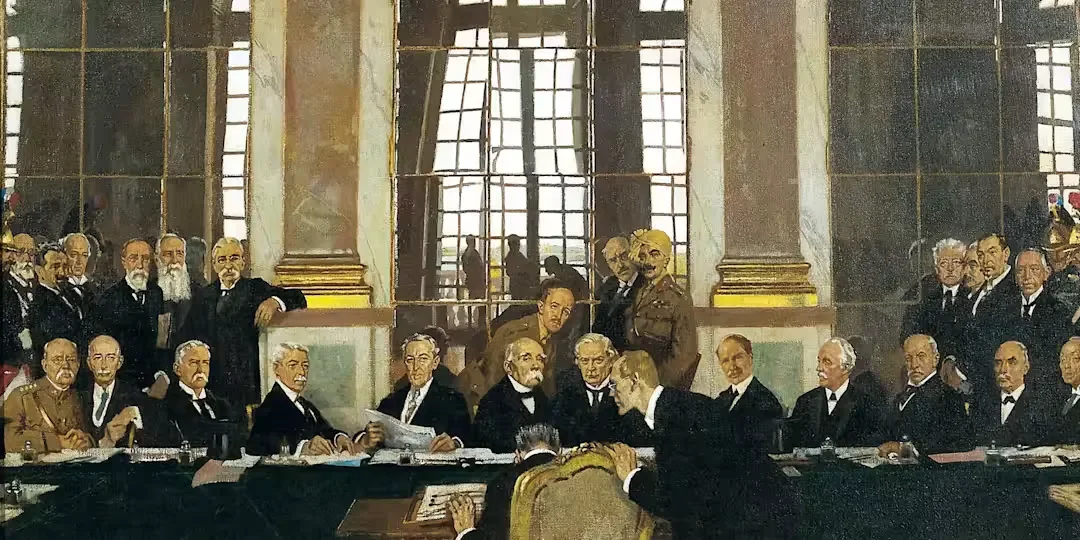
The Signing of Peace in the Hall of Mirrors, Versailles, 28 June 1919
I wonder if that deal those men drew up for them to sign in that house of mirrors, reflecting all of the hate, deceit, vengeance, greed, political opportunism, and worst of all, self-delusion of what a country and people must be, were those problems worth solving if they knew of the coming tomorrow and what it would bring. Solidarity, stability, restoration, none of it was there, nor did they want it. What it means to be a good neighbor, a good friend, is to understand one another, to hear from across the street, meet in the middle of the road, and say, “I hear you. I see you. We are here.” Nothing good comes of men standing in yards and drawing fences, making claims of mine.
Honestly, as much as we were around Max, for all his barking, that was the first time I had understood his bark that day. To hear a lifetime of words and understand a sentence, you’d think it’d be something to build upon. But much like them in a house full of mirrors, I must have shrugged it off and remembered that he owed me his presence. His rehabilitation was paramount. The solution to his sick problem.
Okja, that same super pig. Similarly, a problem that is needed, that is used, exported, and squeezed of everything it contains: love, joy, thought. Everything the problem contains is put through that same factory, cut into the same pieces, and distributed to the different regions and people. A forever problem, continually claiming to look for a fabricated solution to a nonexistent problem. A tool used in order to justify and maintain the economic and political power of those deemed deserving of a voice to speak, no translation required. A child deserving of a dog.
Brother, I don’t know if you’ve ever felt it before, the need to hold on and never let go. I think that’s how they feel, whether they know it or not, or whether they accept it as so. No matter the words you speak, no matter what you say, you can’t translate, because problems are things to solve, not things to have discourse with. You cannot switch to or speak their ideology because it is merely a construction. Their belief comes from impulse; generations of thoughts made to justify and rationalize what they were already going to do. Their personhood and definition of self come before ideology. What comes later is not important because all you see is now. Tomorrow lacks conception when all there is is today.
I thought I was Mija at the end of that film, but now I see I am Tilda Swinton, claiming to fix world hunger in the name of profit, commerce, and wealth. Ending a rebellion that is simply a want of more from a dog I love but could never let go. No matter how many small golden pigs he gave me until they fell out of his hands, I looked on with a blank stare and disgusted face, pulling bolt pistol triggers and walking off, saying aloud, “Why even speak if I can’t understand you?”
You remember, Max was gone the next week. Another escape, another save, another growl and bite at Dad. We sent him over to Auntie’s house, and she loved and adored him the same for years. We still went to see him and love on him, make sure he was there. Same Max, just a different place. A mainstay in the family, so much so that I’ll always remember the howl, the shrieking he let off when Grandma passed. For minutes, he went on as if he had lost one of his own.
But still, same old Max. He had to run away. Got loose, I think she said. I can’t remember now, but gone. Not sure where he is. Ran over, taken in by another family, or hopefully back in the wilderness, back where he desired to be for so long, the home he longed for.
But then I think again: this is no home for a Shiba Inu, is it? Maybe he must settle, find himself happy in a land that he must now call his own and make of it what he will, for he can never, from lack of will, desire, wealth, or understanding, try to cross that sea. So he has regained his freedom, our Max, hunting in the brush like he had always wanted to do.
I wonder if he thinks of us. Remembers our midnight chase, his barking, watching Okja. I wonder if he remembered any of it or ever really cared for it. Maybe a translation that fell on deaf ears. What saddens me most about that night is that even now, on this bed, I know full well that if he stayed with us, I would have known his fate, I would have put him back on his leash and in a crate because he didn’t know any better. He’s a dog. How could I have let him go?
That was the end of the recording to his brother. He set his phone down on the nightstand and turned over. He tried to give me an idea of what to title this one, but like always, I told him we have a system. His ideas don’t help it. We didn’t speak for a while after. I left and shut the door.