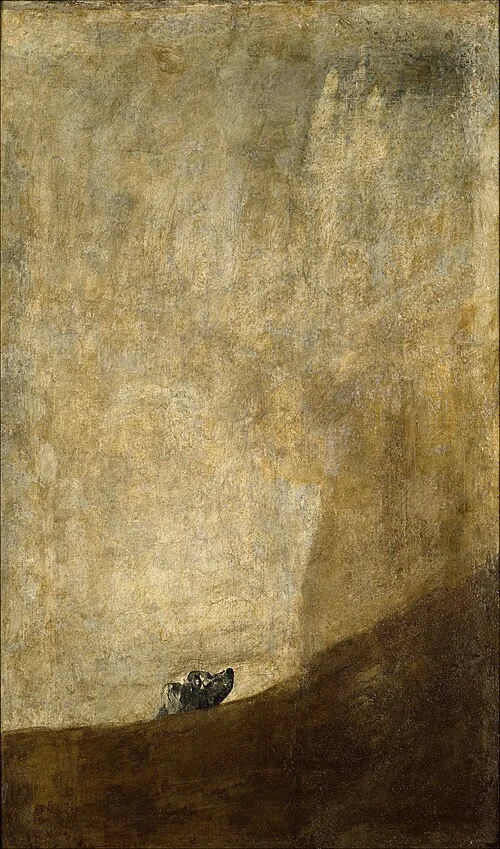
The Drowning Dog by Francisco Goya
She did not speak, give me her name, or her voice; we just sat there among the trees, swaying as the amoral hiss passed through the leaves, unaware of the sun’s gift of luster or reversion to umbra. We sat there for a while on that wooden bench as the ducks paddled through the pond, glazed over green, and people walked past, binoculars in hand or speaking more or as little as her and me. We sat there with the park and the people, like the decomposition of trash within the heap receding to the Earth to become one, like a salve purpose-built to decipher the chronology of Gia’s fissure. “Man’s life of fifty years, against Heaven’s span, Like a dream, a phantom.” That must apply to parks too; at least you can make the case for this one. The park is the last remnant of a time when it spanned the state as marshland. People were conquered and displaced until a city and ports were built on top of one another, reducing the marshland to a section. Then they cut it down further, leaving only an area. Now the remnants reside within a park. A park that one day will become something else, a place of memory, and all that will stand is a tree with a nice golden plaque emblazoned by Midas, with the words, “A park used to be here.” As people kept walking past, she sat next to me, not even a glance, just a subtle shift in her brow, and it came to me. The idea turned into a mournful epiphany, like crestfallen soldiers consecrated to raze cities and damned as they moved toward the next. I wondered whether the next person will sit with her, or can sit with her; how will they see it? Will they see her and the marshlands’ transformation into the cairn that surrounds it? Would they see the bubbling pool of woe that has made up the soul of the park, like a man in the desert passing over tombs sanctioned to write their inscriptions, each plaque a rebuke that spirited away the soul through sand. Did it matter? Did it matter how it appeared, as long as it did? Is this a good thing at all? Maybe that is why so few people notice her presence, because of this very moment. She shows you the truth: the last book of Alexandria, the one that should have outlasted all the others, was burned that night.
As we walked together, I began to understand how large a shadow she actually cast and why they fear her. “All of humanity’s problems stem from man’s inability to sit quietly in a room alone,” she reminded me as we walked through the park. Pascal’s words, and they reign true. You see, with her, as arduous as abrasive as she may be, the botfly buried deep, irritating and fermenting inside the skin through necessity and purpose, she irritates and degenerates all the same. Her reach is everywhere, and you can call her at any moment. But calling her, invoking her presence, is cruel and difficult. I stop looking at the people on the ground and look into the sky and the future, and I see why no one pays attention to her. A device in your hand that houses everything, all that is and all that will be above heaven and Earth; it stands on our makeshift pedestal, conjuring reverence. Larger at home, mid-sized at work, a constant beckoning call, choleric at heart, like the overworked father, like the unfed child, indecent or justified, their ire is felt the same. We plead with it, talking to a friend, finding information, work, romance, pleasure, ad infinitum, because it was purpose-built for that. It does many of those things well, maybe too well. At one point, they promised to decrease your work, to reduce the act of doing. It was a lie, of course, as all technologies sold as productivity increase work, from the laptop to the cotton gin; they make it more accessible and turn you into someone who must do more. The same lie, told by power; the same truth, with its horrid cackle, outside dungeon cage as it sits on its stool. As I watch them watch, she grabs my shoulder, and I am brought back to that reverse dimension called the other. I see why they fear it, why shudder at the very thought of its grip. All of it in there circles you, encloses you. Pascal may have had a point, but you see why man fears the vast lacuna. Your fears, your wants, troubles, mistakes, ad infinitum, all circle you within that space inside of that hold. She may offer solutions, but although the road is paved with good intentions, pandemonium is its final stop, a stop no man in this world would willingly want to call their destination. Willing, however, is not the point, like all these things, all these comforts on the other side of it all. Through the brush and past the thorns, you understand that long ago you chose suffering, and that is the comfort this road affords you.
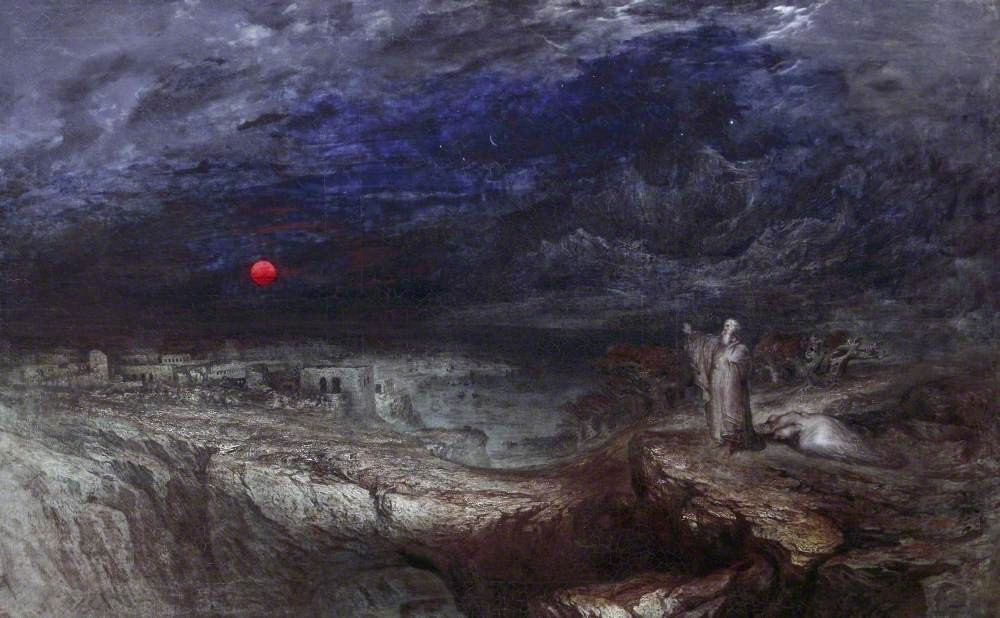
The Last Man by John Martin
We continue walking, and she reminded me of an old parable. A farmer forgot to latch his horse's gate, and it ran away. The neighbor said it was terrible news and bad luck; the man said, “Maybe.” A few days later, the horse came back with six other horses, and the neighbor said how lucky he was, and the farmer said, “Maybe.” The next week, the farmer’s son broke his leg riding the horse, and the neighbor exclaimed What bad luck, and the man said, “Maybe.” The next day soldiers came for all the young men who could fight and left the farmer’s son behind, and the neighbor said How lucky you are. The man said, “Maybe.” This thought swelled within me until we came to a piece of the park I had never seen before, expansive and beautiful. Vast, as if taken from the first fairy tale untainted by human greed and purpose. There, she and I leaned on the railing as I looked on and just thought. It felt freeing, and it was the first time we had been together that way in a while. Usually, I did it in my apartment, walking back and forth, pacing and pacing, frustration filling me as I yelled into the air, the books withdrew as my wrath increased, the air conditioning unit shouted, and the black screen stood there unblinking. Different venues help, but both places offered me the same thing. It would be wrong to say spending time with her makes me erudite, but I'd be lying if I said I had not come closer to it. The idea of a problem seems to tear itself apart when we are together. A problem is defined as a question raised for inquiry, consideration, or solution. We think of it as such a negative thing, a burden, a thing made solely as an affront to our being vacuous and malcontent; it must be berated, stoned like the witch in the square after the trial, but just as that witch walks onto the stage, staring at the mob with their eyes and mouths raised as each nail is placed on the mountain ascent as the noose is wrapped. A problem is none of those things. It is what shoe you choose to wear; from how you decide to end your relationship and give up your passion, we place our hate and disdain on the old dog as she pants for water, as if we did not decide to own her. At that point, you begin to understand why she is here. Idleness, stillness, or constant movement all in service to conjuring her. It may range anywhere from a second to a lifetime, but you will always get there because that is the course of things. Everything you ever wanted to know, every question asked, every problem you received, is on the other side, waiting to be taken. You can only trade eyes so long before you decide to go over and talk to her. Your fear should not be that she rejects you if you are not a fit; the fear is not going at all. The fear is choosing to say nothing. The children, the excitement, the feelings you ask for are there, wrapped in a form you never thought they'd take, but there they are. It could end in a small exchange of pleasantries, and you walk away, but that is just as good as the former, isn’t it? I am sure of it because here on this railing with her I thought of it myself. My absurdity is killed once more, she reminds me, and we understand, more than likely, “we’ll see.”
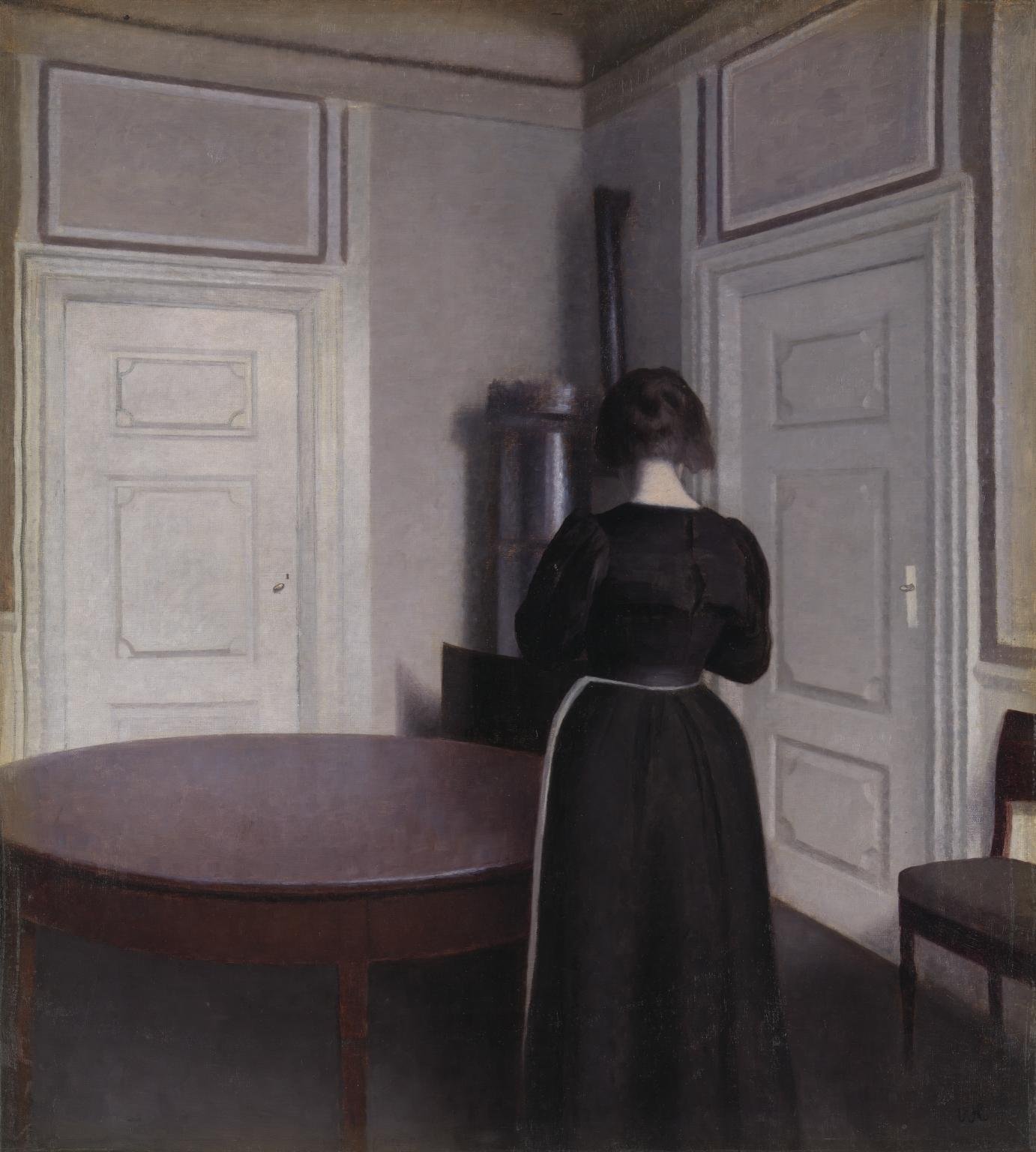
Interior by Vilhelm Hammershøi
We continued along the picturesque valley field, flowers, people, and butterflies, as if I had stepped into a concealed Elysium, hiding away like the smirk of a reprimanded child. We sat on a bench, and I thought about what drives me and what I love. A love that has been inside me since birth, since the first cry; it has been here all along. We all have it, but it varies in appearance; it is the last gift given before we are thrown into man’s gulag. In that gulag, it is a battle every day to determine if we will maintain it or not. Life’s own makings tell you so through stats, data, and studies, all shouting that the attempt is futile.
As we sat and I thought about these, she reminded me of studies that seemed baked into her head, like Pew’s Pursuing the American Dream: Economic Mobility Across Generations, which found that 43% of Americans raised in the bottom fifth of the income distribution remained in the bottom as adults. Only 4% moved from the bottom fifth to the top fifth, and 27% moved up just one rung, meaning 70% never reached the middle class. Your zip code even determines your success: the Opportunity Atlas and the Census Bureau analyzed childhood census tracts. They found that a child born in a below-average opportunity neighborhood, compared with a child born in an above-average opportunity neighborhood within the same county, had lifetime earnings that were $200,000 lower. Georgetown University’s Center on Education and the Workforce’s study Born to Win, Schooled to Lose found that high-achieving disadvantaged children consistently lost ground as they progressed through school, while comparatively low-achieving affluent children often recovered and advanced because they have access to stronger economic and educational safety nets. She also mentioned the study Self-Determination and Meaningful Work: Exploring Socioeconomic Constraints, which examined how social class and perceived freedom to choose work affected people’s ability to find meaningful employment. They found a statistically significant correlation between career choice and meaningful work. You find your job more meaningful when you have more control over it. Lower socioeconomic circumstances restrict your career choice; financial pressures and external motivations are associated with less meaningful work. She told me, as we sat there, that all numbers are findings, that all stats and data are supposed to prove that success is taken away from you. True, but that is seldom proof, and that view misdefines success. Proof came from my friends’ parents and older people I was around, who told me stories about themselves when they were younger. We laughed and smiled until they got to that point. It’s different for everyone: doctor, lawyer, writer, musician, athlete, entrepreneur, magician, photographer, dog breeder, and so on. They stop and talk about what they love for an hour, and if you let them, they could go for hours. They still look into how someone prominent who does it is doing it wrong, how they could have been somebody, or how it would have been nice to do that, at least for a time. Life happens; it happens as soon as you leave and from the moment you are brought back to that zip code, as if the Oracle emblazoned her future premonitions in smoke, the omens are tattooed like a list upon your corpus, wrapping your skin, turned flesh, embodied. That is my data, my proof, I tell her, to all those people who never had a chance, who never got to find their success. Not of wealth or fame, but simply being able to go out in nature and take a picture of a bird that day. Instead, they needed to pay the mortgage or the rent; that is why it was taken from them. That is why they fear you; that is why they detest your presence. I get up and leave her in that valley. Every moment with her is just the bombardment of what they wanted to be.
As good a friend as it is, it makes sense to resist her. To resist is to find the dreams and goals hanging like Damocles’ sword, to be berated for choices you are told are choices, but how else would you live? The world clapping its hands from the sideline: “You can [not] advance; you can [never] resist.” I understand why you scroll; I see why you fill your free time with the noise; I understand why it exists. Who would ever want to face her when she reminds you of it all? Even now, as I walk away and she tries to catch up, I feel it too. Is that really what I want? What if I fail? Is this worth doing? Maybe it does make more sense to stop. It all berates you. It comes for you because she is both angel and devil, giver and taker, the same thing that can take away certainty and cause doubt, all sepulchered in the constant prison of consciousness. It makes sense that you would run away; you would want comfort. In this constant, heavy, mounting fear, I still chose to slow down; I still chose to let her place his hand on my shoulder. She catches up to me, and we sit down again on another bench in the same park, the same land filled with concrete, once perfect, now tearing apart.
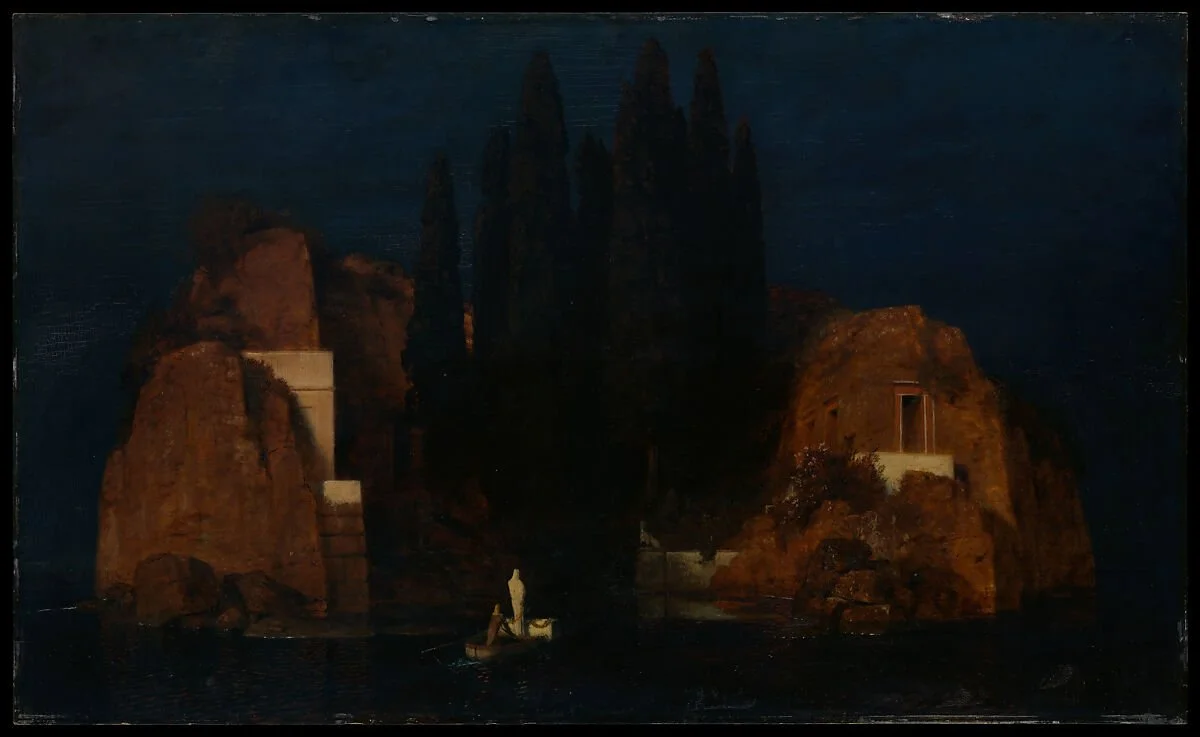
Island of the Dead by Arnold Böcklin
“Man’s life of fifty years, against Heaven’s span, Like a dream, a phantom.” She reminded me of it. Another string of words that haunts me every day. It comes from Atsumori, a warrior hymn that was a favorite of Japan’s unifier, Oda Nobunaga. As I remember it, I understand her importance and her purpose beside me even more. How else would I know she was not there as I paced around the room? How else would I remember if she was not there as I walked through the park? How else would I move forward if she was not there with me as I left the bed? “Man’s life of fifty years, against Heaven’s span, Like a dream, a phantom.” We chase these things, these loves given to us because what else is there to do in a dream? You dream of flying, not being stuck in traffic. You smile because of the beauty life shows you. You move because, at the end of the road, you choose something to reach. With every pressing, depressing matter, you realize your greatest solution is the love you can share. “Man’s life of fifty years, against Heaven’s span, Like a dream, a phantom.” That love can be here only for a time, and it never lets you see how expansive it will be, but love is a tricky thing. You know when you feel it, and you feel it from others. Love does not come small; it is only big, and one feels it the same way another does. However, you cannot find or cultivate love without her beside you, without her to guide you as you navigate it and actualize it. Without her, it’s an impossible journey, stuck in stasis. She may bring her stats, studies, and reluctance, but the love you felt from others on that screen, or from the one you walked past the other day, she gave them the same. She asks if, without it, would the love be real? Would it be worth it? In the worst hour, in the darkest time, love deserves a chance. Love followed becomes love nurtured, love refined, and that love is tempered and honed, shaped and molded, fashioned and curated till it is finally harvested to give to another. Love is passed on and on, and why stop that and break the chain, letting your link fall? Love has a funny way of bringing in that monetary thing we claim to need, because love seen and love felt bring things you never thought you could receive, but that is the thing about love: it finds a way to help you and them. “Man’s life of fifty years, against Heaven’s span, Like a dream, a phantom.” We sat there as I remembered the quote again and again, and I left the bench to write a few ideas I had in my notes. I knew she would be waiting at home; some we would throw out, others we’d pursue, and some we would never get to, but that’s the beauty of her and of love: you give all you can and leave some on the table for someone else to pick up. When they pick it up, the only question I have is how they will take to her there as they find her in the stygian mind. I cannot say if they will hop in her boat or cast her out with the closest thing to obscure her. All I can do is leave it with her.